2013年4月22日月曜日
Fake Japanese Seven-Eleven Commercial (English subtitles)
The following video was shot and edited as a project for the Intro to Media Production class.

Silent TUJ Library
The following video was created as a final project for the Intro to Media Production class.
2013年1月25日金曜日
Into the Camp: Theatrical Analysis of Jean Michel Bruyère’s Le Préau d’un Seul
The following article was written as an assignment for the Theory and Practice of Media Culture class.
Since 2008, the French artist Jean Michel Bruyère and his group LFKs have held an installation-style theatre called Le Préau d'un Seul various times mainly in Europe. In 2012, they had their performance as a part of the program of a performing art festival in Tokyo. The idea of this performance originally came up with the fact that more than 37,000 illegal immigrants are interned in more than 300 internment camps all over Europe today. Since the Tokyo performance was cut off from its cultural and historical context of the original performance, it may have had a different meaning for the Japanese audience. In this paper, I would like to review their performance through my own theatrical experience and analyze what it meant to do the performance in today's Tokyo with the help of a French postmodernist Jean-François Lyotard's theory.
Jean Michel Bruyère is known as a mysterious modern artist. He is known also as a stage and movie director, photographer, and graphic artist. His face photo is not shown either on the festival nor his official websites. He has done various kinds of collective art projects with the group called LFKs which consists of professionals including poets, actors, composers, philosophers, ethnologists and doctors. He even puts a fake biography on his website claiming that he was a past figure in the early 20th century and underwent a sex change and became a woman named Jana Tésárová (Biography). These tricky ways of his authorial representation clearly show that he tries to keep the attention off himself and refuse any kinds of auteurism. What he tries to do here is to draw more attention to the subjects and topics that his artworks suggest, especially the contemporary social issues that are hardly seen but do exist in today's society. One of them is an internment camp issue in Europe today. In his short essay titled "A New Camp in the Coming Age," he claims that "a new type of camp should be created; one that retains basic human rights" ( my translation). The performance's title Le Préau d'un Seul (the Courtyard of One) symbolically suggests the internee's helpless situation in the cell at the camp. It clearly shows that depriving of one's human rights and freedom is his primary concern and the performance more or less reflected his political thought and stance.
Bruyère and his group had then turned the actual camp situation into a form of performing art. In the Tokyo performance, whole classrooms in an old school building and a playground were used as the exhibition site. There were at least eleven installations and performances being held at different rooms and areas. Each of them represented or abstracted the elements of the internees at the camp and the camp itself. Some of them were quite obvious in representation, but the others made the spectators think what they really meant. For example, in the installation room titled La Bascule (the scale), all the photos hung on the wall and the video shown at the corner of the room showed the actual scenes of repatriations that were held in France. Also a big, old canoe standing in the middle of the room, which was actually used for smuggling, was displayed as historical evidence of illegal immigrants. Only the light tone of a whistling tune (a French martial song) heard in the room made the materials look less tragic. On this phase, the objects were merely displayed as they were and the spectators only had to know the facts. There was little space for their imagination and free association to cut in and appreciate the pieces since the objects were too real and concrete.
In the next phase, some parts of the internment camp motif became more abstract and were presented not as facts but as a modified art pieces and performances. At the same time, some historical materials were still used as a prop to make the exhibition look more realistic and focused. For example, in the room called Egging on Room, a few hundred eggs were regularly aligned in cabinets, while the text titled Instruction for Alienating Foreigners by Air under Irregular Circumstances, which was released by the Border Police of France, was read by the performer. In other small rooms called The Camp, miniatures of the internment camps, which were made with white plastics, were displayed in order while the speech by an American Black Panther Party activist was being played on the tape recorder. The former gave the spectators the impression that the room was full of repressive discourses of the law enforcers, whereas the latter made the room filled with anger against them as an effect. In both cases, there was a little space for the spectators to associate the objects freely with other related issues and topics that they knew. These performances and exhibitions were designed to function as the mental preparation for spectators to get more involved in the later performances.
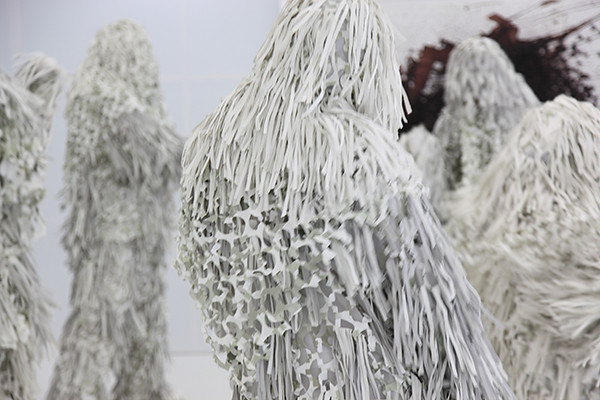
In the next phase, the spectators were arranged to watch the highly abstracted performers as the others. In the room called Dance Floor, several monster-like performers, whose bodies were completely covered with white strips from the head to the toes, were just dancing to music without saying anything. The important point here is that they did not even threaten nor try to interact with the spectators. From the spectator's point of view, they looked totally strange since the spectator could no recognize their faces, genders, skin colors, and ages at all. As a result, they were seen as complete strangers to the spectators. It can be said that in France, the performers might have been seen as French majority's mental image of the foreign immigrants that were recognized as incomprehensible others for them, but the spectators in Tokyo could associate them freely with other issues they could imagine because of their unidentifiable appearance. The same thing can also be said to the exhibition shown in the next classroom called Dark Room. In there, a parody video was being played in front of the spectators. In the video, the monster-like performers acted as if they were the characters of an American TV soap opera The Young and the Restless. Their voices, situation, speeches and actions were same as the original drama. Only their appearances were different. This video strongly suggested that even though they speak and act like the Westerners, their appearances will never change and be recognized as ours from the Western point of view. In a sense, these two performances put the spectators in the position of a distant observer who differentiates oneself from the unidentifiable others.
Before going to the main theatrical experience inside the Tent, there was an installation arranged for the spectators to literally experience the others. The dark room called Fitting Room was located before the gym in which the Tent was installed. In this room, the spectators could wear the monster-like costume (a wig, a costume, and a pair of shoes that were all covered with white strips). Only three people could enter the room at the same time. In there, one could see oneself in the monster costume in the mirror. The floor carpet was made of cow's dried turd. This installation actually let the spectators put themselves in the others' position in the uncomfortable environment. At this point, they had experienced both our and others' points of view toward the internees in the camp.
The most interesting performance at the site was being held in the Tent in the gym. Several performers, who were covered with white surgical costumes, put a thin, black male in a straitjacket, carried him over their shoulders to the outside, and tied him to the apparatus set in the middle of the courtyard. They had repeated this performance again and again for a whole day. The spectators also found the sign in English near the apparatus saying "Please do not feed the foreigner." This ritual performance by the LFK members apparently symbolized the repatriating process. Before entering the Tent, the spectators saw the big sign on it saying "Choose a camp." At this point, they had already experienced the camp situation as the insider and outsider. What was instructed next in the Tent is to be asked to participate in the repatriating act by witnessing the live performance from a close distance. The sign forced them to prepare for the actuality that inevitably involved them into the event even if they did not actively participate in it (they could not go to the next installation without walking by the performance). Being asked to take off one's shoes and be quiet in the Tent made them feel that they were actually in part of the ongoing ritual process. The spectators' theatrical experience at the entire site basically ended at the height of this repatriating performance.
The purpose and meaning of the whole performance can be explored by referring to what Bruyère said in his interview. He said that the entire performance was designed to have the spectators to get involved in and think about the basic structure that cannot be seen in our daily lives. He also said that he set up the theatrical mode so that the spectators could not leave, avoid, or escape from it. As seen above, all the performances were designed not to show how the internment camps really are and address the issue, but to have the spectators experience the issue with minimum explanation. This artistic method shows how art is different from activism and demonstration. In his interview, Bruyère, who was once an activist himself, said that he and his team have never tried to represent the minority group in the society by playing their role in the fiction. Instead, they have tried to make an opportunity for the spectators, most of whom were in majority, to question the way the concept of ‘minority' is used and propagated. As seen above, his installation-style theater was the perfect example to extract the concept of the internment camp issue from the real situation and let the spectators experience it while remaining it in the abstract level and leaving a space for them to freely appreciate it.
Bruyère's attempt to question the usage of `minority' concept also means to question the legitimation of majority and administration that categorizes the minority as so. This was also done in his performance by using the characteristics of science and technology. What was most characterized in the Tent is that all the performers (except the black male who played the internee) wore white surgical coats with white caps, masks and gloves. There were surgical beds and carts as well. Surgical appliances, bandages, and cotton were also there on the desk. X-ray photographs were shown on a PC monitor. All these mise-en-scène implied that the repatriating process proceeded by the performers were based on medical evidence and system which was scientifically seen as correct. These scientific features shown in the performance first seemed a bit odd since medical disguise seemed to be noting to do with the repatriation. It is usually handled by political administration, not by surgical operators. However, the spectators must have become aware that the legitimating power of medical characteristics was being used to justify their seemingly inhuman act. A French postmodernist Jean-François Lyotard wrote about the legitimation of scientific discourse and how it was used by legislators. According to him, "The question of the legitimacy of science has been indissociably linked to that of the legitimation of the legislator since the time of Plato […] [T]here is a strict interlinkage between the kind of language called science and the kind called ethics and politics: they both stem from the same perspective, the same "choice" if you will – the choice called the Occident" (The Postmodern Condition). Though the performance was played without any words, it obviously used tons of medical connotations as a whole to enhance the legitimated atmosphere in the Tent.
The art pieces that the spectators would encounter right after they got out of the Tent were a huge robotic arm which was automatically drawing something on the white sheet on the floor with blood-like ink, and the hospital beds lined up in a row which also kept folding and unfolding by themselves. Beside them, there was a pile of TV monitors that only showed vague images. All these artworks suggested that machines could keep working by themselves without any human help. They might have further implied that technology can replace human jobs (actually, they showed nonsense and insanity of it by letting the machines doing meaningless acts). Regarding technology, Lyotard also pointed out that technology often works to strengthen the legislator's legitimation. He wrote, "By reinforcing technology, one "reinforces" reality, and one's chances of being just and right increase accordingly." Bruyère's attempt was, in a way, to question the legitimating power that is often disguised in scientific and technological discourses. What he did to the spectators, especially when he asked them to "Choose a camp" before entering into the Tent, was what Lyotard called "a language game" or "the game of inquiry" that "immediately positions the person who asks, as well as the addressee and the referent asked about." In this sense, this installation-style theater was very strategic and can be also called very postmodern.
Finally, what it meant for the performance to be held in Tokyo should be examined since the internment issue does not seem to exist in today's Japan. There is a similar social issue that the Japanese spectators might have associated with the term `internment camp': a daiyou kangoku (substitute prison) issue. It is a detention cell in a police station where prosecutors can request as long as 28 days' detention of the suspect without giving any permission to leave under the Code of Criminal Procedure. Since this long detention limits the suspect's basic human rights and often became the cause of false accusation, it has been criticized even by the Human Rights Committee of the United Nations (IRTF). However, this could have hardly been imagined by the performance since the detainee in the substitute prison can be any one of us and is not usually seen as an incomprehensible other like that in France. The internment camp issue does exist in Japan, though. Since Japan has strict immigration laws and rarely certifies the applicants as refugees, the policy actually has led many foreigners who are seeking asylum to be detained in Tokyo Immigration Detention Center for a long period (IRTF). Still the issue is so minor in Japan that most spectators may not have thought of it. It might have been different if there was some information about the internment issue in Japan as well at the site (or at least on the brochure). Due to the different internment camp situation in Japan, it can be said that most Japanese spectators may have not associated the issue with theirs.
The other point that may not have worked for the Japanese spectators to understand the performance is a translation issue. There was a room called Political Bureau at the site. There the performers typed out their thought mainly in French, and handwrote them on big banners. They were later posted up on the fence in the courtyard. The problem here is that the Japanese spectators could not understand what the messages said. There was a small space by the window on the third floor of the building where the Japanese translation of the messages could be read, but that did not help the spectators to feel the impact of the messages when they actually saw the banners in the courtyard (at least there should have been the translation under the banners). In the same way, the sign "Choose a camp" on the Tent may have also received as the message written by foreigners (not us). These language barriers definitely made the installations and performances look more exotic and may not have made the Japanese spectators evoke the similar real situation in their minds. Over all, for the Japanese spectators, the whole installations and performances may have been seen from the outsider's point of view and the performers in both the monstrous and surgical costumes may have been recognized as others for them probably because the performers were both dressed up in white costumes and hid their national and racial identities.
Even though there may have been a cultural gap, Bruyère's attempt to let the spectators experience the internment camp issue was definitely successful to a certain degree. Unlike other art exhibitions, his installation-style theater was designed like an amusement attraction (e.g. a haunted house) so that the visitors could get involved in the installations and performances with great interest. After going through all of them, the visitors may have finally recognized at the exit of the site that what the title of the exhibition, Le Préau d'un Seul (the Courtyard of One), suggested was the desperate feeling of an internee in a camp located somewhere in the world today who is a victim of legitimating power. Even though the cultural background was very different from that in France, the Japanese spectators must have recognized at least this point.
 |
| Inside The Camp |
 |
| Portrait of the artist |
 |
| Inside the Gym |
 |
| Egging on Room |
 |
| Video shown in the Dark Room |
 |
| White monster costume |
 |
| Repatriating ceremony in the Tent |
 |
| Repatriation in the school yard |
 |
| Jean-François Lyotard |
 |
| "Choose a camp" sign on the Tent |
 |
| Concentration camp miniatures |
 |
| Blackboard in the Political Bureau |
Even though there may have been a cultural gap, Bruyère's attempt to let the spectators experience the internment camp issue was definitely successful to a certain degree. Unlike other art exhibitions, his installation-style theater was designed like an amusement attraction (e.g. a haunted house) so that the visitors could get involved in the installations and performances with great interest. After going through all of them, the visitors may have finally recognized at the exit of the site that what the title of the exhibition, Le Préau d'un Seul (the Courtyard of One), suggested was the desperate feeling of an internee in a camp located somewhere in the world today who is a victim of legitimating power. Even though the cultural background was very different from that in France, the Japanese spectators must have recognized at least this point.
2012年12月5日水曜日
Concert Review of Super Orchestra 2012
The following article was written as an assignment for the Exploring Music class.
I went to a classical concert on November 18, 2012 that was held at the Kioi Hall in Yotsuya, Tokyo. It was designed for classical music beginners including teens and young children who were not familiar with classical music. The orchestra played six pieces in total including the two played as encore pieces. Half of them were classical pieces and the other half were the orchestral versions of a movie soundtrack and a TV commercial. In the following paper, I would like to report more in detail about the program and performance, and also discuss what it meant to me, who is still a beginner.
The concert was hosted by the conductor Yukihito Kobayashi, who was the vice-conductor for the Shin-Kokuritsu Theater and also the chorus conductor for the Tokyo Philharmonic and Tokyo Symphony Orchestras. He has held concerts every year since 2009 with amateur musicians as well as a few professionals. The ticket only cost 1,000 yen per adult and he had to ask the audience to donate at the end of the event.
The big hall, which can hold 800 people, was almost full. Among the audience, there were not only many young children and teens, but also many adults. There was an infant who cried at times. His mother had to bring him outside of the hall every time he got cranky, which might have been very unusual for an ordinary classic concert. I sat the six or seven rows from the front on the right side so that I could watch the performance clearly. As a result, I could hear the sounds of the orchestra members turning the pages of their scores and their fiddle sticks hitting the bass strings. This may also have been different from listening classical music on a CD. I had no phone reception inside the hall.
Symphony No. 4 in B flat major (Op. 60) by Beethoven was played first. This piece was written in 1806 and premiered in the next year. The symphony was scored for a large orchestra including flutes, oboes, clarinets, bassoons, horns, trumpets, timpani, and strings. The entire impression of the symphony was very different from Symphony No. 5 which I heard in the class. For me, it sounded gentler, not solemn like Symphony No. 5, and more like a piece made in the classical period. The piece is in four movements. Some parts in the first movement were played in 2/2 in the sonata form, which sounded very interesting. The third movement sounded like a scherzo, but I am not sure. It then became very bright unlike Beethoven's other pieces. The last movement was very fast and strong. The performance lasted about 30 minutes in total.
The next program was The Young Person's Guide to the Orchestra – the Variations and Fugue on a Theme by Purcell, Op. 34. It was composed by Benjamin Britten in 1945 originally for an educational documentary film. It is scored mainly to introduce each family of a large orchestra to beginners. The symphony is in four movements in A minor and A major. The theme is initially played by the entire orchestra. Then the woodwinds, brass, strings, and percussions follow. At the end, they all play together again in fugue. There was a narrator beside the conductor to tell the audience about what each family was composed of. I heard the same piece in class, but it sounded very different. This is probably because there was the narrator who made the piece more understandable. It began to sound so strong at last since the percussions were inserted. The performance lasted about 25 minutes.
The third piece was Boléro. It is a one-movement orchestral piece in C major originally composed as a ballet by Maurice Ravel in 1928. From the beginning to the end, it repeats the same rhythmic pattern (except the very last two bars). There are only two melodies (A and B). According to the conductor, he chose this piece since it could also show every instrument in the orchestra to the audience. At the end, all the instruments got together and left a strong impression. What was interesting for me is that often the string players play the instruments by picking the strings with their fingers without using bows. I felt that the sound was more varied and heavier than that of The Young Person's Guide to the Orchestra although both pieces were played for the same purpose. The performance lasted about 15 minutes.
The last piece in the program was the soundtrack from a famous Japanese anime My Neighbor Totoro (1988). This piece was rearranged for an orchestra by the Japanese music composer Joe Hisaishi, who also composed the soundtrack for the film. According to him, he rearranged the original music and songs into the orchestral version for children and adults who first listen to classical music. He also said that he used The Young Person's Guide to the Orchestra as reference for the rearrangement. The orchestra first played seven different pieces with each family (woodwinds, brass, strings, percussions, and harp + piano at last). Finally all the instruments played the theme of the film. The narrator stood by the conductor and as before and depicted each scene of the film so that the audience could imagine them while listening. There was only one long movement. The piece was targeted toward the child audience. The performance lasted about 20 minutes.
There were two pieces played as an encore. One was the orchestral version of the soundtrack from a popular TV commercial in Japan. It was called Oriental Wind and also composed by Hisaishi. The other one was another orchestral version of Totoro. This is rearranged by the conductor Kobayashi himself and was much shorter than the one just played before (about 10 minutes each). Both two were in one movement. Although their styles were fairly same as the first Totoro, they sounded more dramatic. I saw that the musicians played the pieces relaxed.
Overall, the concert perfectly matched my requirement and interest as a classical music beginner. It was probably the first time that I had attended this kind of classical concert since I became an adult. The orchestra seemed to perform very well. The program really helped me to recognize and understand what kind of the instruments an orchestra consists of. Above all, the impact was so strong that I had been drawn to the beautiful melodies they created almost all through the performance. It was an exciting live music experience for me.
 |
| Kioi Hall |
The concert was hosted by the conductor Yukihito Kobayashi, who was the vice-conductor for the Shin-Kokuritsu Theater and also the chorus conductor for the Tokyo Philharmonic and Tokyo Symphony Orchestras. He has held concerts every year since 2009 with amateur musicians as well as a few professionals. The ticket only cost 1,000 yen per adult and he had to ask the audience to donate at the end of the event.
 |
| Kioi Hall |
 |
| Ludwig van Beethoven |
 |
| Benjamin Britten |
 |
| Maurice Ravel |
 |
| My Neighbor Totoro |
Overall, the concert perfectly matched my requirement and interest as a classical music beginner. It was probably the first time that I had attended this kind of classical concert since I became an adult. The orchestra seemed to perform very well. The program really helped me to recognize and understand what kind of the instruments an orchestra consists of. Above all, the impact was so strong that I had been drawn to the beautiful melodies they created almost all through the performance. It was an exciting live music experience for me.
2012年5月14日月曜日
Audio Clips for Newscast Assignment 2
The followings are two audio clips that I recorded with my own voice and the scripts that I wrote as a newscast assignment for the Writing for Journalism class.
[PSA] Sexually Transmitted Deseases
PSA for Sexually Transmitted Deseases (60 sec. version) by Shinichiro
[Script]
What would you do if you passed sexually-transmitted-disease to your partner without knowing it? The 80-percent of the people infected with chlamydia today didn't notice the symptoms at all. In Japan, chlamydia is the most spread S-T-D. More than one-million people are infected, especially young people. What can you do? Here is the answer: You can have S-T-D testing at the Public Health Service Center in Minato Ward with no fee, no name, and no risk. H-I-V, Syphilis, and Gonorrhea can also be detected with the blood and urine tests. For more information, call 03-3455-4770. English and Japanese speaking staffs are available at the center. Now it's time for you to have S-T-D testing. Not only for you, but also for your partner. This public service announcement is presented by the T-U-J Counseling Office.
[Weather]
Weather News for Newscast by Shinichiro
[Script]
Turning to the weather in Tokyo for this weekend. We had fairly nice weather today. The city of Hachiouji had a high for the day of 20-degrees-Celsius this afternoon. For those of you planning outdoor activities on Saturday, you can expect clear skies for most of the day with high temperatures of 18-degrees. However, things might change by the evening with a storm front moving in. The temperature will drop by the evening. We can expect light scattered showers over the northern part of Tokyo bringing cooler temperatures in the lower teens. This rain should stop by early-Sunday morning. It will be partly cloudy for most of the morning on Sunday, but the clouds should move out by mid-afternoon. Lows should be in the mid-teens, with high around 18. The chance of rain is 15-percent. And that's all for Tokyo's weather for this weekend. I'm Shinichiro Hamazaki reporting from the Temple University's Japan Campus in Tokyo. See you again on Monday.
[PSA] Sexually Transmitted Deseases
PSA for Sexually Transmitted Deseases (60 sec. version) by Shinichiro
[Script]
What would you do if you passed sexually-transmitted-disease to your partner without knowing it? The 80-percent of the people infected with chlamydia today didn't notice the symptoms at all. In Japan, chlamydia is the most spread S-T-D. More than one-million people are infected, especially young people. What can you do? Here is the answer: You can have S-T-D testing at the Public Health Service Center in Minato Ward with no fee, no name, and no risk. H-I-V, Syphilis, and Gonorrhea can also be detected with the blood and urine tests. For more information, call 03-3455-4770. English and Japanese speaking staffs are available at the center. Now it's time for you to have S-T-D testing. Not only for you, but also for your partner. This public service announcement is presented by the T-U-J Counseling Office.
[Weather]
Weather News for Newscast by Shinichiro
[Script]
Turning to the weather in Tokyo for this weekend. We had fairly nice weather today. The city of Hachiouji had a high for the day of 20-degrees-Celsius this afternoon. For those of you planning outdoor activities on Saturday, you can expect clear skies for most of the day with high temperatures of 18-degrees. However, things might change by the evening with a storm front moving in. The temperature will drop by the evening. We can expect light scattered showers over the northern part of Tokyo bringing cooler temperatures in the lower teens. This rain should stop by early-Sunday morning. It will be partly cloudy for most of the morning on Sunday, but the clouds should move out by mid-afternoon. Lows should be in the mid-teens, with high around 18. The chance of rain is 15-percent. And that's all for Tokyo's weather for this weekend. I'm Shinichiro Hamazaki reporting from the Temple University's Japan Campus in Tokyo. See you again on Monday.
2012年4月30日月曜日
Identity Politics at an Academic Seminar on Campus
The following article was written as an assignment for the World Regions and Culture class.
Introduction
A university is a place where a student isolates oneself from the ‘real world’ and cultivates oneself for an academic purpose. At the same time, one can see competition and power politics below the surface among the students. Thus exploring an academic community is interesting in that one can observe the students struggling for their impression management. As Rebekah Nathan writes from an anthropological point of view, a college student is seen at a liminal stage while he/she is in the university (Nathan 2005:146-147). Based on my fieldwork at an academic seminar held at the Japan campus of an American university in Tokyo, I would like to examine and illustrate how an American undergraduate student in an American university tried to represent himself as a member of minority groups and to be accepted as a member of an intellectual American community in a foreign country.
Setting
My fieldwork had been done during an academic seminar that was hosted by a research institute belonging to the American state university’s Japan campus in Tokyo. The settings were as follows: It was a Friday night from 7:30p.m. until 9:00p.m. The seminar was open not only to the students and faculty at the institute and university, but also to the public. It was all done in English. On the third floor of a business building, two classrooms were combined and used as a site. 80-90 seats were available in the room. First only one of the rooms was used, but as more people came, partitions between the two rooms were removed and another room was opened to the audience right before the seminar started. In there, two people shared one table. There was a podium and a big white screen at the front of the room. Two tables with chairs were set beside them for two guest speakers and a moderator to sit. The front area of the classroom was a bit dark during the first half of the seminar due to the use of a projector. After the first speaker finished using it, lights went on. A university’s brochure was left on the table at each seat. There were a few chairs also available on the window side.
Description
 The events during the seminar had occurred as follows: At 7:15p.m., my observation started. This time I attended the lecture as a participant. The seminar was free. No reservation or procedure was needed. I sat at the end of the row at the left corner so that I could observe all the audience members in the room. There were about 20 people in the classroom then. Many were white and aged between 40 and 60. Most of them wore dark-color suits or light-color jackets. Among them, there were a few Asian men (probably Japanese) and a few white and Asian women. There were two undergraduate students (male and female) working as assistant staff. They were helping set up the seminar by checking a video camera position and microphone volume, and setting tables and chairs. I talked with one of them. There were a few graduate-like students in their thirties and several professors that I know in the room. I also saw two black undergraduate students (male and female) in their twenties in the audience. Other than that, I could not see any undergraduate students in the room. Most of the audience seemed like foreigners working in Japan.
At 7:30p.m., the lecture session began. The number of the audience members increased to more than 50 by then. More Japanese-like men were seen in the audience. The director of the institute gave a short speech to the audience. Then the first guest speaker, who was a white, college professor in the U.S., started his lecture using PowerPoint. The topic of the seminar was the 2012 U.S. Presidential election and Republican primaries. The lecturer explained the geographical and historical factors of the Republican Primary race going on in the U.S. in detail. One person in the audience pointed out a mistake in the speaker’s data, but other than that, the audience was listening to the lecturer’s speech quietly and intently.
At 7:50p.m., the first speaker finished his speech and the second guest speaker, who was a white, Tokyo-based political analyst, started his lecture. He did not use PowerPoint. The number of the audience members increased to about 60. The audience laughed once when the speaker made a mistake in telling a candidate’s name. Besides that, they seemed to listen to him quietly and intently. There were two very old white women sitting at the first row near the podium. The older one kept nodding during the speeches.
By 8:12p.m., there were few available seats. In total, there seemed to be about 70 people in the room. 90 percent of them were men. Among them, 10 percent were Asian. There seemed to be no undergraduate students in their twenties in the audience besides the two mentioned earlier.
At 8:15p.m., the second speaker finished his speech and a Q and A session started. During the session, there were about 7 or 8 questioners. All of them were male and all of them except one (an undergraduate student to be mentioned later in this paper) were working adults. They all asked questions related to the U.S. Presidential election. Most of them gave their names and their job titles or company’s names before they asked a question. Among them, an American lawyer, a U.S. official of the Department of Treasury, and a Japanese researcher working at a Japan’s top economic think-tank were included. A few of them seemed to know each other since they mentioned each other’s names in their questions. At the very end, the black male undergraduate student, who was sitting at the end of the last row, raised his hand and asked two questions to the lecturers. One of them was about why a college student like him could not vote from abroad. The other one was about how ‘minority people’ in the U.S. are affecting the election this time. His first question was immediately answered not by the lecturers, but by two of the audience members. Right after he finished asking questions, and before the lecturers opened their mouths, two of the questioners (the lawyer and the U.S. official) commented on his first question. First, the lawyer confirmed with the student that he is a U.S. citizen, and pointed out that he can vote even if he were in Japan. The undergraduate student seemed to understand that what he just said was based on wrong information, and just said “Okay” to him. The lawyer added that he or the U.S. official could help the student on this issue if the student needed their help. He then replied to the lawyer jokingly saying, “I usually don’t trust lawyers, but thanks.” After these exchanges among the audience members, his second question was briefly answered by the lecturers. The Q and A session continued until 9:00p.m., and the seminar finished with a short speech by the director of the institute.
Social events on campus in the U.S.
 Before analyzing the event described above, I would like to explain what an academic event means to an undergraduate student. The fact that very few undergraduate students actually participated at the academic seminar on campus was no surprise to me at all. In general, social events on campus are reported to have become less influential in the last decade as young students become more individualistic. They are more likely to shut themselves in their comfortable friend networks such as on Facebook or among friends from high school. As a result, many college students are less likely to attend social events on campus (Nathan 2005:41-66). Among social events on campus, according to the New York Times, only college sports games (Pappano 2012) and corporate-sponsored promoting campaigns run by hired students (Singer 2011) are the two most powerful social events mobilizing people on campus today. As Nathan pointed out, contemporary college students draw on little academic interests and contacts on campus (Nathan 2005:57). For most students, the university community is experienced as a relatively small, personal network of people who did things together (Nathan 2005:54). Therefore, it is quite understandable that most students did not spare their time to attend the academic seminar even though the topic such as the U.S. Presidential election was familiar and important for them and was held in one of the classroom they usually used.
Analysis
From an anthropological point of view, the point I focused most during the seminar is the Q and A session. In this session, each questioner represented oneself as a ‘qualified’ speaker who had a keen interest in today’s U.S. politics and was intelligent enough to comment on the current political trend with a sharp insight. Their job titles and company’s names would have given them added prestige. This is what Thomas Eriksen describes as a form of impression management, that “Americans may strive to acquire status symbols” (Eriksen 2001:153). They were a minority (foreigners) in Japan, but at this seminar, they were the majority in terms of the language spoken and the topic discussed in the room. In other words, they represented themselves as intellectual elites who could discuss the political issue academically with the experts.
The most interesting questioner was, however, the undergraduate student who asked his questions last. He also tried to represent himself as a representative of dual minority groups. In his first question, he asked why an American student in a foreign country like him did not have a chance to vote. This question sounded more like a complaint against the working adults in the same room. In this case, he represented himself as a representative of other American undergraduate students at the same campus in Tokyo. What he said to the lawyer last clearly showed that the student was positioning himself as an anti-authoritarian. He also positioned himself as a member of ethnic minority groups in the U.S. when he was asking the second question regarding minority effects on the election. This is what often happens in class on campus in the U.S. Nathan writes in her book that “when the [racial or ethnic] subject is raised, as in the occasional class, students of color report being continually expected to educate whites about minority issues or speak” (Nathan 2005:60). In a sense, the undergraduate student just did what minority people are expected to do on campus although the half of his initial attempt unfortunately failed. From an anthropological point of view, he just stepped into the part of the ‘real world’ on his campus with his identity as a college student and also as a member of the ethnic minority group, and faced his immaturity as a result. For him, attending the academic seminar and asking questions to the experts would have been a challenge to become a grown-up adult in the society. In a word, this could be seen as a rite of passage for him in order to be accepted as a politically-conscious American citizen like the other participants.
Conclusion
An academic seminar or conference on campus has ambiguously symbolic meanings. Most of the audience members are usually professionals and experts, but the event is held right in the middle of an undergraduate students’ territory. For the undergraduate students, the seminar is the part of ‘real society’ right next to their ordinary campus life so that they can easily step in and feel the atmosphere of it. My fieldwork this time was based upon these dimensional settings. On an anthropological perspective, a young undergraduate student’s attempt to represent himself in the ‘real world’ was made in the middle of the impression-managing game among the other adult audience members, most of whom have symbolic statuses. It was interesting to observe this symbolic politics played by American people in a classroom in Japan.
Introduction
 |
| My Freshman Year |
Setting
My fieldwork had been done during an academic seminar that was hosted by a research institute belonging to the American state university’s Japan campus in Tokyo. The settings were as follows: It was a Friday night from 7:30p.m. until 9:00p.m. The seminar was open not only to the students and faculty at the institute and university, but also to the public. It was all done in English. On the third floor of a business building, two classrooms were combined and used as a site. 80-90 seats were available in the room. First only one of the rooms was used, but as more people came, partitions between the two rooms were removed and another room was opened to the audience right before the seminar started. In there, two people shared one table. There was a podium and a big white screen at the front of the room. Two tables with chairs were set beside them for two guest speakers and a moderator to sit. The front area of the classroom was a bit dark during the first half of the seminar due to the use of a projector. After the first speaker finished using it, lights went on. A university’s brochure was left on the table at each seat. There were a few chairs also available on the window side.
Description

At 7:30p.m., the lecture session began. The number of the audience members increased to more than 50 by then. More Japanese-like men were seen in the audience. The director of the institute gave a short speech to the audience. Then the first guest speaker, who was a white, college professor in the U.S., started his lecture using PowerPoint. The topic of the seminar was the 2012 U.S. Presidential election and Republican primaries. The lecturer explained the geographical and historical factors of the Republican Primary race going on in the U.S. in detail. One person in the audience pointed out a mistake in the speaker’s data, but other than that, the audience was listening to the lecturer’s speech quietly and intently.
At 7:50p.m., the first speaker finished his speech and the second guest speaker, who was a white, Tokyo-based political analyst, started his lecture. He did not use PowerPoint. The number of the audience members increased to about 60. The audience laughed once when the speaker made a mistake in telling a candidate’s name. Besides that, they seemed to listen to him quietly and intently. There were two very old white women sitting at the first row near the podium. The older one kept nodding during the speeches.
By 8:12p.m., there were few available seats. In total, there seemed to be about 70 people in the room. 90 percent of them were men. Among them, 10 percent were Asian. There seemed to be no undergraduate students in their twenties in the audience besides the two mentioned earlier.
At 8:15p.m., the second speaker finished his speech and a Q and A session started. During the session, there were about 7 or 8 questioners. All of them were male and all of them except one (an undergraduate student to be mentioned later in this paper) were working adults. They all asked questions related to the U.S. Presidential election. Most of them gave their names and their job titles or company’s names before they asked a question. Among them, an American lawyer, a U.S. official of the Department of Treasury, and a Japanese researcher working at a Japan’s top economic think-tank were included. A few of them seemed to know each other since they mentioned each other’s names in their questions. At the very end, the black male undergraduate student, who was sitting at the end of the last row, raised his hand and asked two questions to the lecturers. One of them was about why a college student like him could not vote from abroad. The other one was about how ‘minority people’ in the U.S. are affecting the election this time. His first question was immediately answered not by the lecturers, but by two of the audience members. Right after he finished asking questions, and before the lecturers opened their mouths, two of the questioners (the lawyer and the U.S. official) commented on his first question. First, the lawyer confirmed with the student that he is a U.S. citizen, and pointed out that he can vote even if he were in Japan. The undergraduate student seemed to understand that what he just said was based on wrong information, and just said “Okay” to him. The lawyer added that he or the U.S. official could help the student on this issue if the student needed their help. He then replied to the lawyer jokingly saying, “I usually don’t trust lawyers, but thanks.” After these exchanges among the audience members, his second question was briefly answered by the lecturers. The Q and A session continued until 9:00p.m., and the seminar finished with a short speech by the director of the institute.
Social events on campus in the U.S.
Analysis
 |
| Small Places, Large Issues |
The most interesting questioner was, however, the undergraduate student who asked his questions last. He also tried to represent himself as a representative of dual minority groups. In his first question, he asked why an American student in a foreign country like him did not have a chance to vote. This question sounded more like a complaint against the working adults in the same room. In this case, he represented himself as a representative of other American undergraduate students at the same campus in Tokyo. What he said to the lawyer last clearly showed that the student was positioning himself as an anti-authoritarian. He also positioned himself as a member of ethnic minority groups in the U.S. when he was asking the second question regarding minority effects on the election. This is what often happens in class on campus in the U.S. Nathan writes in her book that “when the [racial or ethnic] subject is raised, as in the occasional class, students of color report being continually expected to educate whites about minority issues or speak” (Nathan 2005:60). In a sense, the undergraduate student just did what minority people are expected to do on campus although the half of his initial attempt unfortunately failed. From an anthropological point of view, he just stepped into the part of the ‘real world’ on his campus with his identity as a college student and also as a member of the ethnic minority group, and faced his immaturity as a result. For him, attending the academic seminar and asking questions to the experts would have been a challenge to become a grown-up adult in the society. In a word, this could be seen as a rite of passage for him in order to be accepted as a politically-conscious American citizen like the other participants.
Conclusion
An academic seminar or conference on campus has ambiguously symbolic meanings. Most of the audience members are usually professionals and experts, but the event is held right in the middle of an undergraduate students’ territory. For the undergraduate students, the seminar is the part of ‘real society’ right next to their ordinary campus life so that they can easily step in and feel the atmosphere of it. My fieldwork this time was based upon these dimensional settings. On an anthropological perspective, a young undergraduate student’s attempt to represent himself in the ‘real world’ was made in the middle of the impression-managing game among the other adult audience members, most of whom have symbolic statuses. It was interesting to observe this symbolic politics played by American people in a classroom in Japan.
2011年12月13日火曜日
What Would Jane Jacobs Think If She Saw the Process of Building Roppongi Hills?
The following article was written as an assignment for the Humanities Seminar II class.
 Roppongi Hills, a mega-complex that covers 11.6 hectares of the area in Tokyo, is often mentioned as one of the largest and most successful city renewal projects that have ever been made after World War II in Japan. The project started in 1984 and took about 17 years to complete. The plan involved the city government, the land developer Mori Building Co., and the residents living in the construction area. Just to reach agreements with 500 right holders, the company had spent over 15 years. The concept of the renewal plan seems totally opposite from that of Jane Jacobs, but there is a point in the history of this Roppongi renewal plan that is equivalent to her philosophy. Jane Jacobs’ idea regarding a local community in the city was accidentally realized in the process of building the Roppongi Hills in Japan half a century after Jacobs published her book.
 The most distinct feature of Roppongi Hills is not its immense and luxurious looks, but the enormously long and complicated process to compete the project which may be unimaginable for Jane Jacobs. In 1986, TV Asahi Co., which owned the main part of the location, decided to make a new headquarters building there and consulted the Minato Ward Office and Mori Building Co. The Ward suggested that they should also redevelop the surrounding area since it was packed with wooden houses, small apartments, and condominiums with narrow streets which made it difficult for fire engines to come into the area in an emergency. After the district was officially designated as a redevelopment inducement area by Tokyo Metropolitan Government in the same year, Mori Building started to negotiate with the residents there. According to Mori Building, their first contact with the residents was totally unwelcoming. Most of the residents did not listen to them at all, but after their repeated visits at each resident’s house at least once every two weeks, many of them gradually opened their hearts and listened to what the developer said. The company explained to them that the plan was not a buyout. It was the joint reconstruction of their houses and apartments. The company opened two offices in Roppongi and started releasing newsletters twice a month to inform the residents of the present situation of the plan. The residents also started town meetings and information sessions to understand the plan more and find out what was the most beneficial for them. Through these meetings, the residents put together their thoughts and gave some requests to the developer such as preserving an old pond in the area and widening the construction area. In 1990, five local communities merged. At first the community members set the new Roppongi Hills opening day sometime in 1996, but it actually took 7 more years to complete. This was just the beginning of the long partnership between Mori Building and the residents living at the site. There was still a long way to go.
 The residents in the construction area and Mori Building still had many problems to solve. Under the city redevelopment law, the residents established the Redevelopment Preparatory Association and the plan was finally approved by the Ward in 1998. While the renewal plan was being developed by Mori Building, Minato Ward, and 90% of the residents and stakeholders, there were a few residents who were still against the plan. What they were asking the developer to do was to guarantee that their living standards would be secured the same as before and they would not take any financial risk before they signed the contract. Land prices were decreasing in the 1990s in Japan right after the financial bubble burst. The company did not want to make guarantees to them in that situation (but they finally won assurances by the company’s CEO). Under the city redevelopment law, once residents establish the Redevelopment Preparatory Association for the redevelopment and the plan is approved by the government, all the right holders in the planned area are automatically part of the association even if a person is against the plan. He/she then has to decide whether to stay or leave in 30 days (most of the opposing members moved to the surrounding areas after the final agreements were made with the company). The opposing members put pressure on the Ward Office to stop the project, claiming that the developer had not disclosed the detailed information to the residents yet. Four lawsuits were brought by the residents and right holders. Even after agreements with most of the residents, Mori Building still needed to solve other problems. One of them was how the units in the new buildings would be equitably allocated to each right holder, which took another half a year to solve. The company also had to provide temporary accommodations for the residents while the construction was going on. It built several new apartments around the area just for that purpose. While there were some noise pollution claims by the neighbors during the construction, Roppongi Hills finally opened in April, 2003. By the end, 93% of the residents and right holders agreed on the project and 400 people out of 500 moved in to the new residential buildings (The anti-construction group said the figure is not correct and cannot be that high. According to them, many right holders moved to other places during the negotiation period and the way Mori Building counted residents at the beginning was not appropriate). Finally, it took 17 years to finish the entire project.
 Unlike the other parts of Jane Jacobs’ ideas regarding city planning, what she said ideally regarding a local community in her book The Death and Life of GreatAmerican Cities is just what happened to the residents in Roppongi, facing a city renewal plan led by a big company. She basically criticized what city planners usually did to the residents in the redevelopment area:
 This situation may actually occur even today in the world after half a century passed since the publication of this book. In some countries, the government may still have enough power to uproot the residents from construction sites, but that does not happen in Japan. For example, few small wooden houses owned by the farmers who are against the construction can still be seen in the middle of the runways at Narita Airport today. This example shows that the Japanese government does not have enough power to evict the residents from the site for any reason, due to the strict land expropriation law. The same thing has happened everywhere in Japan where redevelopment is planned. Only huge disasters or events such as Meiji Restoration in 1867, Great Kanto Earthquake in 1923, Great Tokyo Air Raids in 1945, and Tokyo Olympics in 1964 have given governments the chances to redevelop the wide areas in Tokyo that needed to be reformed. Today only private corporations can implement and complete the redevelopment with their incentives, professional skills, and financial power. The power balance between a developer and residents in Japan has to be examined in this context. Jacobs pointed out some conditions for a local community to fight city officials. According to her, the leaders of the community should represent the opinion in the community and be the opinion makers at the district level (Jacobs 125). Furthermore, she said, “Effective districts … must their citizens who are in agreement with each other on controversial questions act together…” (127). After she argued these general requirements for a local community, she explained what was actually needed to develop the community saying that the members “must have time to find each other, time to try expedient cooperation [sic] – as well as time to have rooted themselves, too, in various smaller neighborhoods of place or special interest” (134). These are the very relationships that had been fostered between the residents in Roppongi described above. They actually spent 15 years to reach agreements among them and with the developer. During that period, they communicated with each other probably much more than the residents in the other areas did. Here the developer functioned as a coordinator between the residents who leads them toward the goal. Mori Building clearly understands the importance of the partnership with the local residents. It says on its website:
 Jane Jacobs is often seen as an anti-government/corporation activist because of her protests and criticism of city planners and governments. Her main concept of city planning may be totally opposite from that of Mori Building. It is very clear that the total concept of Roppongi Hills is heavily influenced by Le Corbusier’s city idea (e.g. high-rise residential towers, roof gardens, etc.). In fact, Mori Building’s CEO Minoru Mori owns a private collection of drawings, paintings, and sculptures by Le Corbusier (Bremner), and he is the one whom Jacobs heavily criticizes in her book (21-24) as one of the roots of all evil of useless city planning. Even with the differences in philosophy, however, similar ideas can be found between Jacobs and the recent city redevelopment in Tokyo today.
Roppongi Hills, a mega-complex that covers 11.6 hectares of the area in Tokyo, is often mentioned as one of the largest and most successful city renewal projects that have ever been made after World War II in Japan. The project started in 1984 and took about 17 years to complete. The plan involved the city government, the land developer Mori Building Co., and the residents living in the construction area. Just to reach agreements with 500 right holders, the company had spent over 15 years. The concept of the renewal plan seems totally opposite from that of Jane Jacobs, but there is a point in the history of this Roppongi renewal plan that is equivalent to her philosophy. Jane Jacobs’ idea regarding a local community in the city was accidentally realized in the process of building the Roppongi Hills in Japan half a century after Jacobs published her book.Unlike the other parts of Jane Jacobs’ ideas regarding city planning, what she said ideally regarding a local community in her book The Death and Life of GreatAmerican Cities is just what happened to the residents in Roppongi, facing a city renewal plan led by a big company. She basically criticized what city planners usually did to the residents in the redevelopment area:That such wonders may be accomplished, people who get marked with the planners’ hex signs are pushed about, expropriated, and uprooted much as if they were the subjects of a conquering power. Thousands upon thousands of small businesses are destroyed, and their proprietors ruined, with hardly a gesture at compensation. Whole communities are torn apart and sown to the winds, with a reaping of cynicism, resentment and despair that must be heard and seen to be believed. (Jacobs 5)
Our designs for future cities are always in partnership with local residents. We know that our goals cannot be achieved without mutual relationships with other stakeholders. The process always begins by engaging them in frank dialogue, listening to their views, and formulating agreed-upon plans. This is the basis for our city planning, which has never changed and will never change (“Urban Design”).The development of the local community in Roppongi perfectly fit the three requisites that Jacobs gave for the growth of the district network: “a start of some kind; a physical area with which sufficient people can identify as users; and Time” (136), which can be paraphrased as “the redevelopment plan in Roppongi that took as long as 17 years.” Only on this point in city planning, Jacobs’ idea perfectly matches the situation of the residents in the Roppongi area.
Jane Jacobs is often seen as an anti-government/corporation activist because of her protests and criticism of city planners and governments. Her main concept of city planning may be totally opposite from that of Mori Building. It is very clear that the total concept of Roppongi Hills is heavily influenced by Le Corbusier’s city idea (e.g. high-rise residential towers, roof gardens, etc.). In fact, Mori Building’s CEO Minoru Mori owns a private collection of drawings, paintings, and sculptures by Le Corbusier (Bremner), and he is the one whom Jacobs heavily criticizes in her book (21-24) as one of the roots of all evil of useless city planning. Even with the differences in philosophy, however, similar ideas can be found between Jacobs and the recent city redevelopment in Tokyo today.2011年10月20日木曜日
Digital Story Compilation
The following article was written as an assignment for the Cyberspace and Society class.
Here is my video for one of the digital storytelling assignments. I gathered all the photos that I took for the daily shoot assignment and edited them into a video. Although each photo is a crap taken by my poor mobile-phone camera, with a great help of good background music, a series of photos generates a certain kind of atmosphere of where I live and what I do everyday. It was good that I could "reuse" what I've done earlier for the class and attach another meaning to them. I hope you can also feel a bit of my not-so-exciting school life in Tokyo.
Music: "Pacific II" by William Ackerman
Video edited by Windows Live Movie Maker
For more details: Digital Storytelling Compilation
Here is my video for one of the digital storytelling assignments. I gathered all the photos that I took for the daily shoot assignment and edited them into a video. Although each photo is a crap taken by my poor mobile-phone camera, with a great help of good background music, a series of photos generates a certain kind of atmosphere of where I live and what I do everyday. It was good that I could "reuse" what I've done earlier for the class and attach another meaning to them. I hope you can also feel a bit of my not-so-exciting school life in Tokyo.
Music: "Pacific II" by William Ackerman
Video edited by Windows Live Movie Maker
For more details: Digital Storytelling Compilation
登録:
投稿 (Atom)