2013年4月22日月曜日
Fake Japanese Seven-Eleven Commercial (English subtitles)
The following video was shot and edited as a project for the Intro to Media Production class.

2013年4月18日木曜日
Web-driven Social Activism in Japan
The following article was written as an assignment for the Journalism and Society class.
As more people become constantly connected online through computers and mobile devices in the last few years, more social
demonstrations and protests have been organized and done all over the world with the help of the Internet. The situation is the same
in Japan. There have been many social demonstrations and protests organized with the help of various social networking services such
as Facebook, Twitter, YouTube, Nico Nico Douga (a Japanese video-sharing site), IRC (Internet Relay Chat), and 2channel (the Japan's
biggest bulletin board site). Japanese web-driven activism has its unique characteristics. Participants tend to hide their real
identities and keep anonymous while participating in protests and activities. Japanese tendency to be anonymous online is often
pointed out in earlier study (Bovee and Cvitkovic, and McLelland), but has not examined yet in detail with the recent demonstrations
and the uses of social networking services. In this paper, I would like to examine how the recent web-driven social activism has been
operated on different web platforms and services in Japan, and finally show how anonymity plays an important role in the Japanese
demonstrations and protests.
There were roughly four notable web-driven social protests and activities occurred in 2012 in Japan. One of them that drew most media
attention was the anti-nuclear demonstration held in front of the Prime Minister's Office in Tokyo. It was organized by a group
called Metropolitan Coalition Against Nukes (MCAN). It started in March 2012 and continued weekly since then. The number of
participants has, however, decreased from 21,000 at a maximum to several hundreds today (estimated by police. "Anti-nuke Protests").
At their peak, they even had an official 30-minute interview with the then Prime Minister Noda in the Office (Nakanishi). There are
several characteristics that are particular to MCAN. One of them is that they are a single-issue group. Their only purpose is to stop
all the nuclear power plants in Japan. The group leader banned the participants to claim other political issues during the protests.
The other interesting point is that they mainly use Twitter and Facebook for announcements ("First Anniversary"). It was these
social networking services that increased the number of participants from 300 at first to "200,000" at its peak (according to MCAN.
"Anti-nuke Protests"). Another point is that only a very small number of individuals have identified themselves in the group. On the top of their website, there is a list of anti-nuclear groups that join MCAN. It makes sense since they call themselves "a network, not a group," but there is no individual name on the list other than the name "voluntary individuals" ("Sanka Gurupu" All translation mine) added at the end. Regarding the protesters, the organizer does not know who they are since the MCAN's messages are retweeted again and again on Twitter. People usually participate in the protests without telling their true identities (some even wear masks to cover their faces). Even the representative of the group, Misao Redwolf, does not reveal her real name. Still, many
participants show their faces and protest even in front of TV crews. Overall, the organizer and participants seem to conceal their
individual identities, whereas the demonstration itself is quite visible from the outside.
The other notable demonstration that drew the media attention recently is anti-Korean protests that have been done since 2012 at
Shinokubo in Tokyo. It was organized by an ultranationalist group called Zainichi Tokken o Yurusanai Shimin no Kai (Citizen Group That Will Not Forgive Special Privileges for Koreans in Japan), also known as Zaitokukai. Their hate speeches such as "Kill Koreans!" and "Get rid of the cockroaches from Japan!" were so aggressive and racist that they often had conflicts with the local Korean residents ("Arita Appeals"). They have also made racist insults against other foreigners including Chinese and the Westerners. They started their activities in 2007 and now have 9,000 members. They have local branches all over Japan and routinely hold small-scale
demonstrations (Fackler). One of the interesting points of this group's activities is that they use videos to show their performances on YouTube and Nico Nico Douga and appeal to their viewers effectively on the web. They shoot several videos on each demonstration they do and upload them on these sites regularly so that they can get more supporters through these sites. They are said to be strongly supported by netouyo, the Net far-right group known as anti-Korean and Chinese. Their demonstration videos are popular enough to go to the upper part of the video chart in the politics category on Nico Nico Douga, which is the Japan's largest video-sharing site with more than 30 million registered users. Since the site has its own unique streaming comments function in which the other users' comments go from right to left on the screen while watching. The viewer feels as if he or she is watching a live video together with the other viewers. The comments are short and quick to fade out, and most of them are shouts and agitations. Unlike those on YouTube, it is rare to find calm and rational comments that can be developed into a productive discussion. Instead, watching the aggressive attacks of the protesters in the video with hundreds of hateful comments overlapped on it is so visually impressive that the viewer feels as if he or she were in the same heat with the protesters and other viewers. This pseudo live-experience on Nico Nico Douga is the key driving force for Zaitokukai to gain today's popularity on the web.
The other interesting point of Zaitokukai's activities is that like MCAN, the members do not identify themselves in public. Even the
founder and representative of the group Makoto Sakurai (which is not his real name) does not reveal his own identity. At their
demonstrations, many participants wear sunglasses and masks during the march in order not to identify themselves. They are also a
single-issue group like MCAN and do not have a concrete ideology such as the Nazi's racial supremacy theory. They are loosely
connected through the Internet and get together only for the demonstrations (Fackler). The web supporters who watch the group's
videos on Nico Nico Douga are even more anonymous. They do not reveal their names either since a viewer cannot trace the comments back to the original posters. Even if he or she can, almost no user uses his or her real name on Nico Nico Douga and does not use his or her face-photo icon, either. Overall, it can be said that the protesters are present in the real world just like the MCAN
participants, but hide their true identities more than the anti-nuke protesters do. The supporters are more invisible than those of
MCAN since Facebook and Twitter that the MCAN supporters often use for spreading information are more identity-oriented and less
anonymous than Nico Nico Douga.
Inarguably, the most notorious and aggressive web-based activism in Japan today is Kijo group that bases on particular threads on
2channel. 2channel (also known as 2chan) is "the biggest BBS in the world" (Katayama) with 2-3 million comments posted a day on more than 800 active boards (Suzume graph). The estimated number of the active users of the site is between 12 and 16 million (Matsutani). There are a variety of boards on any kind of topic that one can think of, even on harmful and illegal topics such as murders, weapons, drugs, and poison. Due to the size of the site, some boards are chaotic and become a lawless area so that the threads are filled with illegal drug deals, prostitution ads, gun sales, and even death threats. However, the distinctive feature of this site is that all the messages can be posted totally anonymously without any registration. Although the IP address can be detected and shown to the police by request in the worst cases such as a death threat (open proxies are banned from posting on 2channel), all the comments are posted under the name of "anonymous." On the other hand, since the posters can hide their real identities, they tend to confess their true feelings more and often leak their company's secret information on the boards. In essence, 2channel works as the outlet of complaints and angers accumulated in the society. This is especially true in Japan where people have to say tatemae (public statement) and honne (personal feeling) separately in their daily communication with others. Although the boards are full of slander, hate speeches, and defamation and 99.9% of the comments are useless, "an excellent source of information" (Matsutani) can be found here. That is why news organizations follow 2channel closely to find news sources and see the public mood (Onishi and CNN).
Among the huge numbers of the threads on 2channel, the Kijo threads are known as the most fearful and aggressive ones. Kijo is an
abbreviation for kikon josei, which means married women in Japanese. The threads were originally made for married women to chat about
their daily topics. The direction on the top of the threads clearly says that the threads are only for married women and others cannot post any comments there. What actually happens on these threads is that the posters intensively dig up the personal information of an ordinary person or celebrity in the latest news and reveal it on the threads. They have such excellent searching skills both on the web and in the real world that they disclose any kinds of personal information including the person's photo, address, school/company's name, phone number, and email address. They reveal the person's family information as well. They sometimes go to the related locations and upload photos. At the same time, they encourage other viewers to make phone calls and send emails to the person's school or company as well as asking to report the event to police and authorities. They continue to reveal the information until the person shuts down his or her blog, and deletes his or her Facebook, Twitter, and email accounts. In the worst case, the targeted person often has to change his or her school and workplace because of these attacks. For example, several jr.-high school students, who bullied their classmate to death in Shiga prefecture in 2011, were set as targets by the Kijo group since media did not report their names (because they were minors) and the school committee did not investigate the case at first. In this case, all the personal information of the students, their family members, and the class teacher were disclosed on the threads. Most of them finally had to move and change their schools ("Student Suicide"). This is typically how the person on a target is crucified on the Kijo threads.
The Kijo group is different from the MCAN and Zaitokukai cases in the point that they do not show themselves in the real world or on
the web at all. Their real identities are hard to trace. It is doubtful that they are actually married women even though their
comments sound very feminine. According to a survey done by an Internet survey company, the estimated active users on the Kijo threads who spend more than two hours per month are about 16,000, but married women account only for 36% of the total. Single women account for 16% and the rest are probably men in their 30s and 40s (Yamamoto). Since their postings cannot be identified with particular individuals, there is little community feeling (McLelland 822). In a word, they emerge as a collective unconsciousness on the web that searches for a target to hang up.
Among all the recent big web-driven activism in the world, the most famous one is definitely the protests done by a hacker group
called Anonymous. They usually use IRC to discuss issues and communicate with others. They have a strong link to Japan. Christopher
Poole adopted the 2channel system and made the same anonymous BBS called 4chan in 2003, on which the Anonymous was originally formed.
They had also attacked and crashed authorities' and companies' servers in Japan in June 2012 due to the protest against the new laws that ban illegal downloading. While this was done by the AnonOps (the mainstream of Anonymous), the OpJapan (a Japanese branch of the group) took a different approach to the issue. They did a cleanup activity in Tokyo wearing a suit and Guy Fawkes' mask without saying anything or holding placards. On July 7th, 2012, about 50 Anonymous members gathered, picked up garbage, and handed out leaflets that explain why they were doing so to the passerby ("Dos and Don'ts").
Although they call the activity "off-meeting, not a protest" ("Dos and Don'ts"), this protest style is very different from those
of the other groups mentioned above. First of all, they identified themselves as the members of Anonymous and showed themselves in the real world with Anonymous characteristics. Unlike the MCAN and Zaitokukai demonstrators, they strongly presented themselves as a
character so that they can keep their clear online identity while hiding their individual ones. On their website, they listed detailed directions and rules for the participants such as "Act politely" and "Don't do any activities that go against the laws"
("Dos and Don'ts." Translation mine). The event was vastly reported on more than 20 news outlets in Japan and the world. It was a well-
defined, successful media representation of the group while keeping their true identities anonymous.
The four protest styles mentioned above have different degrees of anonymity in their activities, but in all the cases, the
participants' real names are not shown. These degrees of online anonymity can be roughly classified into three phases (Bovee and Cvitkovic 42-43). The lowest degree of anonymity can be called visual anonymity, at which the person usually retains some connection
to the real self in the society (e.g. email address). The second level is the dissociation of identity, in which the person adopts a
new online identity (such as a handle name or graphical avatar). The highest level of anonymity is the total lack of identification.
On this level, the person lacks an avatar or any label that would mark him or her as an individual. According to these anonymity
classifications, the MCAN protesters can be categorized as the visual anonymity since many of them use Facebook that links the person
to his or her real identity. They also show themselves on the street without any disguises. The demonstrators of Zaitokukai can also
be categorized in this level since some of them show their faces in the video, but their online supporters who watch their videos and
post comments on Nico Nico Douga are on the lack-of-identification level since only their comments are left without any avatars or
nicknames (a comment poster's nickname and avatar are traceable on YouTube). The Kijo group on 2channel is surely categorized as the
lack-of-identification level since there is nothing but their comments and it is almost impossible to identify them. On the other
hand, the OpJapan group of Anonymous is categorized as dissociation of identity since they all have the unique character of Anonymous.
How do the different degrees of online anonymity affect the formation of the group then? According to the Social Identity Model of Deindividuation Effects (SIDE model) on computer-mediated communication (CMC), "the combination of anonymity and group immersion [...] or interaction via computer network [...] can actually reinforce group salience and conformity to group norms" and "perceive the self and others not as individuals with a range of idiosyncratic characteristics and ways of behaving, but as representatives of social groups or wider social categories" (Postmes T, Spears R, and Lea M 697). Based on this SIDE model, it is very clear that anonymity highly worked for MCAN and Zaitokukai to form and develop their groups to the sizes of today. It can also be inferred that all the four groups strongly believe in their doing something good for ‘social justice.' Another CMC study shows that online anonymity fosters deindividuation and a more impersonal, task-oriented focus (Walter 361). This is also backed by the MCAN strategy that more people could participate in the protests because the events were single-issue rather than multi-issue. The MCAN staff had deliberately removed the protesters who claimed other social and political issues in the demonstrations and declined to change their single issue to wider social problems. They keep themselves away from old left-wing social activist groups, too (Nakanishi). Zaitokukai also does not bring Japanese traditional Shintoism or militarism into their policy like old right-wing groups and represent themselves just as xenophobia (some participants hold Japanese imperial flags during the protests). The Kijo group on 2channel intensively search and attack the target as long as the personal information is there. They immediately vanish when the target is knocked off and there is no more information to dig up. All the examples show that unlike the old social and political activists and protesters in the 60s and 70s, today's Japanese protesters seem to temporarily gather on a single issue and avoid one's activities being seen as a part of one's character or personality by the others in their real lives.
The point that single-issue protests do not seem to last long or gain popularity in Japan can be examined from another point of view.
The fact that the Liberal Democratic Party of Japan (LDP) won a substantial victory on the Lower House elections in December 2012
shows that even the MCAN, which once had more than 20,000 people in the protest, could not have enough influential power on the public to bring its issue to politics because the LDP is the only party that did not insist on anti-nuclear policy during the election campaign (all the other parties that claimed anti-nuclear drastically lost their seats). Zaitokukai, Kijo group, and Anonymous still cannot gain broad support from the public in Japan and are just seen as evil in the digital era. These cases suggest that their online anonymity kept them from gaining popularity and credibility from the public and developing into the mainstream in Japan.
Overall, the examples of the recent web-driven activism in Japan mentioned above obviously show that "Japanese seem to prefer greater anonymity online" (Bovee and Cvitkovic 50), but it can also be said that unlike the other big web-driven social movements such as Arab Spring and Occupy Wall Street in the world, these activities in Japan would have never occurred through Facebook. This is probably because the site does not allow anonymity and fake identities at all for its users. The huge expansion of 2channel clearly shows that Japanese need a virtual space to let out all the frustrations anonymously that pile up in their stuffed tatemae/honne society.
 |
| Metropolitan Coalition Against Nukes (MCAN) |
 |
| Metropolitan Coalition Against Nukes (MCAN) |

 |
| Zainichi Tokken o Yurusanai Shimin no Kai (Zaitokukai) |
 |
| Makoto Sakurai |
 |
| 2channel |
 |
| Kijo threads on 2channel |
 |
| Kijo threads' icon |
 |
| Anonymous |
 |
| Anonymous Cleaning Service in Shibuya |
 |
| Hierarchical conditions of anonymity |
 |
| Metropolitan Coalition Against Nukes (MCAN) |
 |
| LDP leader Shinzo Abe |
Overall, the examples of the recent web-driven activism in Japan mentioned above obviously show that "Japanese seem to prefer greater anonymity online" (Bovee and Cvitkovic 50), but it can also be said that unlike the other big web-driven social movements such as Arab Spring and Occupy Wall Street in the world, these activities in Japan would have never occurred through Facebook. This is probably because the site does not allow anonymity and fake identities at all for its users. The huge expansion of 2channel clearly shows that Japanese need a virtual space to let out all the frustrations anonymously that pile up in their stuffed tatemae/honne society.
2013年3月11日月曜日
Art or Child Porn: Analysis on Japanese and English Media Coverage
The following article was written as an assignment for the Journalism and Society class.
Many artists have battled with social norms throughout history all over the world. Contemporary artists especially shock spectators and question their moral standards in their exhibitions. In January 2013, a Japanese contemporary artist Makoto Aida and the Mori Art Museum, which hosted his art exhibition "Aida Makoto: Monument for Nothing," received a letter of protest from a feminist group saying that his works are child pornography and injure the dignity of women. Both Japanese and the U.S. media reported the news in various ways. In this paper, I would like to examine how the news was reported both in Japanese and English media and show how Japanese and the U.S. legal definitions of child pornography and cultural tendencies may have led to the different types of media coverage on the event as a result.
The news was simple as follows: Aida, who is known for his erotic and grotesque depictions of young girls, wars, and other controversial subjects, and the Mori Art Museum were protested by a feminist group called People Against Pornography and Sexual Violence (PAPS). The group insisted that his works, especially Dog Series (1996) featuring naked, underage-looking girls leashed like a dog with their limbs dismembered, are "child sexual abuse and commercial sexual exploitation" and such a work "normalizes such discrimination and violence, and actively promotes the sexual exploitation of girls, violence against women, and discrimination and contempt for people with a disability" (PAPS). They asked the museum to remove all the related works, but it refused to do so. Instead, Aida and the museum released an announcement saying that part of the exhibition was hidden behind a black curtain and restricted to visitors 18 years old or older with caution. The exhibition is now being held and there have not been any other protests.
 Various media outlets have reported the news differently including mainstream news papers and foreign press. Japanese mainstream media such as Daily Yomiuri Online (reported in English), Mainichi.jp (deleted), and Sankei News covered the protest. It was also listed on the Yahoo News. Mainichi, which is seen rather as liberal in Japanese media, reported the story just in brief, whereas Yomiuri and Sankei, which are often seen as conservative in Japan, covered it in more detail with Aida's artistic career. The Yahoo news was distributed from a legal website called Bengoshi.com, which pointed out that the art pieces are not considered as child pornography from a legal point of view. An alternative online news site such as J Cast News reported it in more detail with Aida's interview and what the Internet users said about it. Japanese news media for foreigners such as Metropolis and The Japan Times had long art reviews in English with several photos of Aida's artworks. Their articles explored why he made them and what their themes were. The international news press such as Bloomberg Businessweek covered the news, which was then quoted by a blogger of The Huffington Post and reported in its Art and Culture section. These are the articles that can be collected on the Internet at this moment.
 Within the limited numbers of the news reports mentioned above, it is fair to say that Japanese media (excluding the ones that reported in English) seem to have reported the story briefly as news, whereas the foreign media (including Japanese ones that reported in English) seem to have reported it as a part of an art review, not merely as news. They are more likely to appreciate Aida's works as art and suggest inspiring comments to the readers. For example, they interpret his works and what they mean to Japanese society like "[His works] depict taboo subjects and also shed light on people's sense of shame" (Daily Yomiuri), "Aida manages to give his paintings a façade of ugliness, inanity and frivolity, while at the same time imbuing them with wit, beauty, irony and pathos" (The Japan Times), and "Pornography is just one of the many devices he employs to provoke the viewer to reexamine everyday aspects of Japanese culture and see what lurks beneath the calm surface" (Businessweek). The blogger of The Huffinton Post even asks the readers to "[s]ee a slide show of the work below, and let us know your thoughts in the comments" (The Huffinton Post). English reporting media is more likely to examine an art event more in depth and offer a controversial point of view for the readers to think about it. In an article of The Japan Times, the writer even analyzes Japanese culture and society through this exhibition ("the painting has [...] something to do with Japan's obsession with cuteness – the so-called culture of kawaii") (The Japan Times).
 There are various reasons why the Japanese reporting media just covered the event as news. One of them comes from Japan's poor art-reviewing culture in news media. Usually Japanese mainstream newspapers do not include cultural and art reviews in their weekend editions unlike British and American standard newspapers. Since the Japanese media do not cover an art event in their culture and art sections in depth, an art event is often briefly reported as news. A controversial issue is not likely to be debated on news media outlets, either. Most of all, the main reason that made the issue difficult to debate in news media outlets is the ambiguous definition of the term child pornography in Japan. Under Japan's laws, production, distribution, dissemination, and possession for sale of child pornography depicting children under 18 years of age is a criminal offence since 1999 just like the same laws in other Western countries (except that possession is still legal in Japan). What makes the Japan's child porn laws very different from the other countries', especially those of the U.S., is the ambiguous definition of the term. It is simply written as "arouses or stimulates the viewer's sexual desire." This ambiguity allowed the protest group to call Aida's works "child porn" (PAPS) and made the Japanese media reluctant to go into deeper argument on the issue. The other point that might have made the argument difficult is the fact that vast child pornographic images in Japanese manga and anime are not real and are difficult to certify as child porn. Since the purpose of Japanese child porn laws is to protect junior victims, it is difficult to apply them directly to the anime and manga characters that do not exist in the real world. Even though 86.5% of respondents of a poll are for the regulation of art depicting child porn, the government cannot do so because of the facts mentioned above and also the fear that the laws may infringe the freedom of speech, press, and all other forms of expression. All these arguments on child porn may make Japanese news media hesitate to put in-depth art reviews of the exhibition on their websites.
 On the other hand, the English reporting media had a deeper analysis of the exhibition because they have a clearer distinction between porn and art than Japanese media and also regularly publish art their reviews on their pages. In terms of child pornography in the U.S., child pornography is defined under 18 U.S.C. §1466A and §2252A. The provisions are a little more in detail than those of Japan, but the most contrasting feature is that they have a line saying that an image that "lacks serious literary, artistic, political, or scientific value" (§1466A) is defined as child pornography. In other words, some artistic pieces are seen as an art piece even though there are some visual elements of sexual abuse of children in it. This is perfectly reasonable and understandable since the provisions may violate the freedom of speech without these exceptions. Hollywood movies such as Traffic and American Beauty could be categorized as child porn and banned if there were no such a clause. The same thing can be said to visual child porn. Actually, the U.S. Government introduced the Child Pornography Prevention Act of 1996, but the U.S. Supreme Court struck down the law in 2002 for the same reason for the protection of art values. The Government again issued the improved PROTECT Act of 2003 instead, but it still cannot ban all the images that they initially intended to. American media, including Businessweek and The Huffington Post, at least have such a legal background to appreciate and discuss the controversial pieces as art, whereas Japanese media may have hesitated to do so because they have a vague legal boundary between art and child porn although its society is full of such images.
 However, the main issue that both the protest group and the museum focused on was not whether the art pieces are child pornography or not, but whether they could be displayed in a public place such as a museum or not. In the letter of protest, what the group called for is the removal of related works from the exhibition. Aida was well aware of the problem, too and said, "There are some among my works that can't be openly exhibited in public art museums" in his interview posted on the museum website long before he received the letter from the group. He even said, "I had always thought of some of the works to be displayed in the R18 room (like the "Dog" series) as almost certainly too much for an art museum to show openly" and "I wouldn't think of insisting against everyone's better judgment that my more confronting works be hung in such a public arena." He said this especially because young children may be in the audience of the exhibition. These statements show that he shared the same concerns as the protest group from the beginning and finally decided to display some of his works in the restricted area. The focus of the argument is then more on how artistic values and community standards go together, which is not particularly discussed in any media that was mentioned earlier.
As shown above, English reporting media was more likely to report the art event in a review form to give the readers clues to judge whether it is worth visiting or not, whereas Japanese media rarely offered critical points of views on the event for the readers and just covered it merely as news. This is because Japanese media intends to avoid controversial issues and does not have enough art appreciating practices in its media outlet on a daily basis as a whole. On the other hand, the Japanese media did not really focus on the issue that the protest group and the museum focused on. As The Japan Times' article cited above suggested, it is true that a sense of kawaii, which is often translated as cuteness in English, plays a huge role in people's preference in Japanese society today. There could have been a critical analysis on Japanese society using this term as a key word through the review of the exhibition.
 |
| Makoto Aida |
 |
| Dog series |
As shown above, English reporting media was more likely to report the art event in a review form to give the readers clues to judge whether it is worth visiting or not, whereas Japanese media rarely offered critical points of views on the event for the readers and just covered it merely as news. This is because Japanese media intends to avoid controversial issues and does not have enough art appreciating practices in its media outlet on a daily basis as a whole. On the other hand, the Japanese media did not really focus on the issue that the protest group and the museum focused on. As The Japan Times' article cited above suggested, it is true that a sense of kawaii, which is often translated as cuteness in English, plays a huge role in people's preference in Japanese society today. There could have been a critical analysis on Japanese society using this term as a key word through the review of the exhibition.
2013年2月22日金曜日
Representation of Japanese Culture in The Simpsons’ episode
The following article was written as an assignment for the Journalism and Society class.
 In The Simpsons' episodes, the family traveled to Japan several times and experienced a variety of cultural gaps there. Their experience is depicted with irony and exaggeration, and often become a little too aggressive toward the targeted Japanese and their culture. The episodes clearly show how average American audience perceives Japan and its culture. In this paper, I would like to examine one of The Simpsons' Japanese episodes and analyze how it represents Japanese culture and how its ethnic jokes works for the U.S. audience.
 The Simpsons is well known for its numerous references to the U.S. sub-culture in a single episode. The one titled Thirty Minutes Over Tokyo, which was originally aired on May 16, 1999 in Season 10, is also full of references to Japan and its subculture (the episode's title itself comes from an old movie called Thirty Seconds Over Tokyo (1944)). Before the family members bring up any topics regarding Japan at the beginning of the episode, several words that are usually associated with Japan in the U.S. are brought into the story. One of them is a term technology referred by Marge and represented as the form of a Wired magazine that she is reading. The other term is a word monkey referred by Bart saying “I know the Internet that shows monkeys' doing it.” These words seem to coincidentally appear in the scene, but the same topics appear again in the form of an ethnic joke on Japanese just six minutes later. It can be said that the first references to the topics actually forecast the upcoming jokes that relates to the episode's main topic. They become warming up for the audience to imagine about Japan from the title of the episode. On a plane to Tokyo, Bart says, “If we want to see Japanese people, we can just go to the zoo.” It is clearly understood by the audience that he seems to say that Japanese look like a monkey when Lisa says “Homer!” to Bart right after that. Bart then replies to her saying “What? The guy who washes the elephants is Japanese... his name is Takashi... he's in my book club.” Here a typical feature of how The Simpsons deals with offensive jokes in its episodes can be observed. The family members do not actually say the offensive sentence in a word, but make the audience to imagine of it based on the context. Right after the allusion, they usually blame the offensive idea or joke from a politically correct point of view (usually it is done by Lisa and Marge), or say the counter opinion to it. In this case, Lisa corrects the idea and Bart himself shows that the Japanese is a person who has his name, occupation, and intelligence (by labeling him as a book-club member) just like the other people in the U.S., unlike a stereotyped monkey image.
 The same idea-correction right after an offensive joke is also shown later in the episode. At the sumo tournament, Bart throws the Japanese Emperor out of the ring into a box full of sumo thongs and all the Japanese audience in the stadium starts booing. This also clearly shows to the U.S. audience that being rude to the Emperor is very much offensive to ordinary Japanese people (the same kind of an offensive joke on the Japanese Emperor is also shown in the several episodes of South Park, but political correction or a counter opinion to it is never been shown).
 The main topic that is criticized and made fun of most in the episode is cruelty of a Japanese TV game show. The interesting point here is that even though it is about Japanese a TV show, it also becomes a keen critique of TV shows in general in the U.S. In the 2000s, there were many Japanese TV game shows aired in the U.S. They usually featured amateur competitors and had them play cruel games. Takeshi's Castle (2003) is the first one of its kind. There were many others such as Sasuke (American Ninja Warriors) (2006) and Hole in the Wall (2008). There was even an American original program called I Survived a Japanese Game Show (2008) in a reality-TV trend at the time. Before these shows aired in the U.S., the original Japanese shows had been watched on YouTube and became very popular all around the world including the U.S. One of the reasons these shows became a YouTube hit is that most of them are slapstick and did not need any words to understand, but still keep a strong story of the battle. What is remarkable about The Simpsons' episode is that it was aired way before the Japanese TV game show boom started. YouTube (started in 2004) had not launched yet when the episode was aired in 1999 in the U.S. It means that not many Americans had a chance to watch Japanese game shows on TV or the Internet at the time. It also shows that the episode eventually foresaw what came next on TV to the U.S. in the next ten years. At the end of the episode, after having a series of harsh physical challenges and finally receiving tickets to go back to Springfield, Bart says to a Japanese TV host as he leaves the stage as a competitor, “Game shows aren't about cruelty. They are about greed and wonderful prizes [...] but somewhere along the line, you lost your way. What a shame.” Right after this line, Bart watches the same show on TV in a waiting room and laughs at a Canadian couple in the show saying “Lovely show.” This part is added in order to show Bart's (and also ordinary TV audience's) ambivalent personality and to balance the tone of the episode not to become too preachy. However, his comment directly points out the moral issue of a TV game show that asks the audience if they really want to watch the devastating competitors and laugh at them.
 In the same way, all the Japanese images that appear numerously during the episode are in fact not laughed at by the Simpson's family. Rather, the images are used to make fun of the Simpsons' reactions to Japanese culture. Moreover, all the Japanese images are more likely to be distorted and fake ones that are often appeared in the U.S. media at the time. This can be pointed out by counting a number of monsters shown in the episode including Godzilla, Rodan, Mosura, Ghidorah, and Gamera, all of which were once popular in the U.S. They also show robotic anime program called “Battling Seizure Robots” (which also indicates Pokemon) on the TV in a hotel room and Hello Kitty factory from the window with a lot of meaningless Japanese characters all through the story. The Simpsons encounter the stereotyped American figures as well including Marilyn Monroe, Muhammad Ali, Statue of Liberty, and a sheriff's golden badge in a restaurant called America Town. Here they also see stereotyped images of the U.S. and hear many ironic jokes about their culture from a Japanese waiter. In a sense, what the U.S. audience sees about Japanese culture in the episode is paralleled with the stereotyped images that Simpsons encounter in Japan. This paralleled structure of gazing at a different culture may lead some audiences to see the wider media situation from a more distant point of view and think about the media bias existing both in Japan and the U.S.
Overall, The Simpsons has many offensive jokes in its episodes, but they usually deny the idea behind them or add countering ideas. Furthermore, the family clearly shows a similar situation of a typical American audience surrounded by the biased media by referring to a variety of knowledge that they may receive from TV, which is the moment when “Parody encourages viewers to reflect upon media messages and structures” (Gray 236). The Simpsons even “invites the viewer beyond its cutout world to give critical consideration to the way society and the media engage ethnic prejudice” (Sienkiewicz and Nick Marx 17) to a certain degree. After all, what parody shows is the mere reflection of the viewers themselves.
Overall, The Simpsons has many offensive jokes in its episodes, but they usually deny the idea behind them or add countering ideas. Furthermore, the family clearly shows a similar situation of a typical American audience surrounded by the biased media by referring to a variety of knowledge that they may receive from TV, which is the moment when “Parody encourages viewers to reflect upon media messages and structures” (Gray 236). The Simpsons even “invites the viewer beyond its cutout world to give critical consideration to the way society and the media engage ethnic prejudice” (Sienkiewicz and Nick Marx 17) to a certain degree. After all, what parody shows is the mere reflection of the viewers themselves.
2013年1月25日金曜日
Into the Camp: Theatrical Analysis of Jean Michel Bruyère’s Le Préau d’un Seul
The following article was written as an assignment for the Theory and Practice of Media Culture class.
Since 2008, the French artist Jean Michel Bruyère and his group LFKs have held an installation-style theatre called Le Préau d'un Seul various times mainly in Europe. In 2012, they had their performance as a part of the program of a performing art festival in Tokyo. The idea of this performance originally came up with the fact that more than 37,000 illegal immigrants are interned in more than 300 internment camps all over Europe today. Since the Tokyo performance was cut off from its cultural and historical context of the original performance, it may have had a different meaning for the Japanese audience. In this paper, I would like to review their performance through my own theatrical experience and analyze what it meant to do the performance in today's Tokyo with the help of a French postmodernist Jean-François Lyotard's theory.
Jean Michel Bruyère is known as a mysterious modern artist. He is known also as a stage and movie director, photographer, and graphic artist. His face photo is not shown either on the festival nor his official websites. He has done various kinds of collective art projects with the group called LFKs which consists of professionals including poets, actors, composers, philosophers, ethnologists and doctors. He even puts a fake biography on his website claiming that he was a past figure in the early 20th century and underwent a sex change and became a woman named Jana Tésárová (Biography). These tricky ways of his authorial representation clearly show that he tries to keep the attention off himself and refuse any kinds of auteurism. What he tries to do here is to draw more attention to the subjects and topics that his artworks suggest, especially the contemporary social issues that are hardly seen but do exist in today's society. One of them is an internment camp issue in Europe today. In his short essay titled "A New Camp in the Coming Age," he claims that "a new type of camp should be created; one that retains basic human rights" ( my translation). The performance's title Le Préau d'un Seul (the Courtyard of One) symbolically suggests the internee's helpless situation in the cell at the camp. It clearly shows that depriving of one's human rights and freedom is his primary concern and the performance more or less reflected his political thought and stance.
Bruyère and his group had then turned the actual camp situation into a form of performing art. In the Tokyo performance, whole classrooms in an old school building and a playground were used as the exhibition site. There were at least eleven installations and performances being held at different rooms and areas. Each of them represented or abstracted the elements of the internees at the camp and the camp itself. Some of them were quite obvious in representation, but the others made the spectators think what they really meant. For example, in the installation room titled La Bascule (the scale), all the photos hung on the wall and the video shown at the corner of the room showed the actual scenes of repatriations that were held in France. Also a big, old canoe standing in the middle of the room, which was actually used for smuggling, was displayed as historical evidence of illegal immigrants. Only the light tone of a whistling tune (a French martial song) heard in the room made the materials look less tragic. On this phase, the objects were merely displayed as they were and the spectators only had to know the facts. There was little space for their imagination and free association to cut in and appreciate the pieces since the objects were too real and concrete.
In the next phase, some parts of the internment camp motif became more abstract and were presented not as facts but as a modified art pieces and performances. At the same time, some historical materials were still used as a prop to make the exhibition look more realistic and focused. For example, in the room called Egging on Room, a few hundred eggs were regularly aligned in cabinets, while the text titled Instruction for Alienating Foreigners by Air under Irregular Circumstances, which was released by the Border Police of France, was read by the performer. In other small rooms called The Camp, miniatures of the internment camps, which were made with white plastics, were displayed in order while the speech by an American Black Panther Party activist was being played on the tape recorder. The former gave the spectators the impression that the room was full of repressive discourses of the law enforcers, whereas the latter made the room filled with anger against them as an effect. In both cases, there was a little space for the spectators to associate the objects freely with other related issues and topics that they knew. These performances and exhibitions were designed to function as the mental preparation for spectators to get more involved in the later performances.
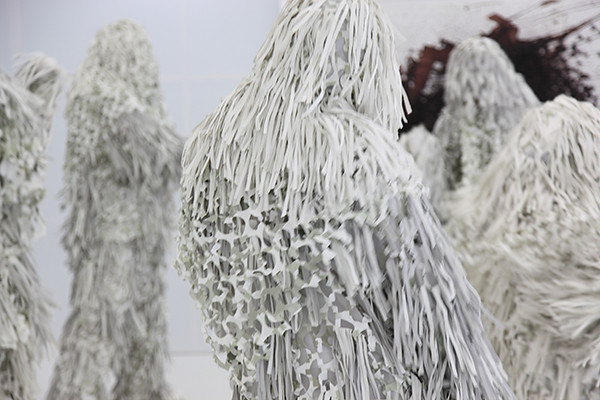
In the next phase, the spectators were arranged to watch the highly abstracted performers as the others. In the room called Dance Floor, several monster-like performers, whose bodies were completely covered with white strips from the head to the toes, were just dancing to music without saying anything. The important point here is that they did not even threaten nor try to interact with the spectators. From the spectator's point of view, they looked totally strange since the spectator could no recognize their faces, genders, skin colors, and ages at all. As a result, they were seen as complete strangers to the spectators. It can be said that in France, the performers might have been seen as French majority's mental image of the foreign immigrants that were recognized as incomprehensible others for them, but the spectators in Tokyo could associate them freely with other issues they could imagine because of their unidentifiable appearance. The same thing can also be said to the exhibition shown in the next classroom called Dark Room. In there, a parody video was being played in front of the spectators. In the video, the monster-like performers acted as if they were the characters of an American TV soap opera The Young and the Restless. Their voices, situation, speeches and actions were same as the original drama. Only their appearances were different. This video strongly suggested that even though they speak and act like the Westerners, their appearances will never change and be recognized as ours from the Western point of view. In a sense, these two performances put the spectators in the position of a distant observer who differentiates oneself from the unidentifiable others.
Before going to the main theatrical experience inside the Tent, there was an installation arranged for the spectators to literally experience the others. The dark room called Fitting Room was located before the gym in which the Tent was installed. In this room, the spectators could wear the monster-like costume (a wig, a costume, and a pair of shoes that were all covered with white strips). Only three people could enter the room at the same time. In there, one could see oneself in the monster costume in the mirror. The floor carpet was made of cow's dried turd. This installation actually let the spectators put themselves in the others' position in the uncomfortable environment. At this point, they had experienced both our and others' points of view toward the internees in the camp.
The most interesting performance at the site was being held in the Tent in the gym. Several performers, who were covered with white surgical costumes, put a thin, black male in a straitjacket, carried him over their shoulders to the outside, and tied him to the apparatus set in the middle of the courtyard. They had repeated this performance again and again for a whole day. The spectators also found the sign in English near the apparatus saying "Please do not feed the foreigner." This ritual performance by the LFK members apparently symbolized the repatriating process. Before entering the Tent, the spectators saw the big sign on it saying "Choose a camp." At this point, they had already experienced the camp situation as the insider and outsider. What was instructed next in the Tent is to be asked to participate in the repatriating act by witnessing the live performance from a close distance. The sign forced them to prepare for the actuality that inevitably involved them into the event even if they did not actively participate in it (they could not go to the next installation without walking by the performance). Being asked to take off one's shoes and be quiet in the Tent made them feel that they were actually in part of the ongoing ritual process. The spectators' theatrical experience at the entire site basically ended at the height of this repatriating performance.
The purpose and meaning of the whole performance can be explored by referring to what Bruyère said in his interview. He said that the entire performance was designed to have the spectators to get involved in and think about the basic structure that cannot be seen in our daily lives. He also said that he set up the theatrical mode so that the spectators could not leave, avoid, or escape from it. As seen above, all the performances were designed not to show how the internment camps really are and address the issue, but to have the spectators experience the issue with minimum explanation. This artistic method shows how art is different from activism and demonstration. In his interview, Bruyère, who was once an activist himself, said that he and his team have never tried to represent the minority group in the society by playing their role in the fiction. Instead, they have tried to make an opportunity for the spectators, most of whom were in majority, to question the way the concept of ‘minority' is used and propagated. As seen above, his installation-style theater was the perfect example to extract the concept of the internment camp issue from the real situation and let the spectators experience it while remaining it in the abstract level and leaving a space for them to freely appreciate it.
Bruyère's attempt to question the usage of `minority' concept also means to question the legitimation of majority and administration that categorizes the minority as so. This was also done in his performance by using the characteristics of science and technology. What was most characterized in the Tent is that all the performers (except the black male who played the internee) wore white surgical coats with white caps, masks and gloves. There were surgical beds and carts as well. Surgical appliances, bandages, and cotton were also there on the desk. X-ray photographs were shown on a PC monitor. All these mise-en-scène implied that the repatriating process proceeded by the performers were based on medical evidence and system which was scientifically seen as correct. These scientific features shown in the performance first seemed a bit odd since medical disguise seemed to be noting to do with the repatriation. It is usually handled by political administration, not by surgical operators. However, the spectators must have become aware that the legitimating power of medical characteristics was being used to justify their seemingly inhuman act. A French postmodernist Jean-François Lyotard wrote about the legitimation of scientific discourse and how it was used by legislators. According to him, "The question of the legitimacy of science has been indissociably linked to that of the legitimation of the legislator since the time of Plato […] [T]here is a strict interlinkage between the kind of language called science and the kind called ethics and politics: they both stem from the same perspective, the same "choice" if you will – the choice called the Occident" (The Postmodern Condition). Though the performance was played without any words, it obviously used tons of medical connotations as a whole to enhance the legitimated atmosphere in the Tent.
The art pieces that the spectators would encounter right after they got out of the Tent were a huge robotic arm which was automatically drawing something on the white sheet on the floor with blood-like ink, and the hospital beds lined up in a row which also kept folding and unfolding by themselves. Beside them, there was a pile of TV monitors that only showed vague images. All these artworks suggested that machines could keep working by themselves without any human help. They might have further implied that technology can replace human jobs (actually, they showed nonsense and insanity of it by letting the machines doing meaningless acts). Regarding technology, Lyotard also pointed out that technology often works to strengthen the legislator's legitimation. He wrote, "By reinforcing technology, one "reinforces" reality, and one's chances of being just and right increase accordingly." Bruyère's attempt was, in a way, to question the legitimating power that is often disguised in scientific and technological discourses. What he did to the spectators, especially when he asked them to "Choose a camp" before entering into the Tent, was what Lyotard called "a language game" or "the game of inquiry" that "immediately positions the person who asks, as well as the addressee and the referent asked about." In this sense, this installation-style theater was very strategic and can be also called very postmodern.
Finally, what it meant for the performance to be held in Tokyo should be examined since the internment issue does not seem to exist in today's Japan. There is a similar social issue that the Japanese spectators might have associated with the term `internment camp': a daiyou kangoku (substitute prison) issue. It is a detention cell in a police station where prosecutors can request as long as 28 days' detention of the suspect without giving any permission to leave under the Code of Criminal Procedure. Since this long detention limits the suspect's basic human rights and often became the cause of false accusation, it has been criticized even by the Human Rights Committee of the United Nations (IRTF). However, this could have hardly been imagined by the performance since the detainee in the substitute prison can be any one of us and is not usually seen as an incomprehensible other like that in France. The internment camp issue does exist in Japan, though. Since Japan has strict immigration laws and rarely certifies the applicants as refugees, the policy actually has led many foreigners who are seeking asylum to be detained in Tokyo Immigration Detention Center for a long period (IRTF). Still the issue is so minor in Japan that most spectators may not have thought of it. It might have been different if there was some information about the internment issue in Japan as well at the site (or at least on the brochure). Due to the different internment camp situation in Japan, it can be said that most Japanese spectators may have not associated the issue with theirs.
The other point that may not have worked for the Japanese spectators to understand the performance is a translation issue. There was a room called Political Bureau at the site. There the performers typed out their thought mainly in French, and handwrote them on big banners. They were later posted up on the fence in the courtyard. The problem here is that the Japanese spectators could not understand what the messages said. There was a small space by the window on the third floor of the building where the Japanese translation of the messages could be read, but that did not help the spectators to feel the impact of the messages when they actually saw the banners in the courtyard (at least there should have been the translation under the banners). In the same way, the sign "Choose a camp" on the Tent may have also received as the message written by foreigners (not us). These language barriers definitely made the installations and performances look more exotic and may not have made the Japanese spectators evoke the similar real situation in their minds. Over all, for the Japanese spectators, the whole installations and performances may have been seen from the outsider's point of view and the performers in both the monstrous and surgical costumes may have been recognized as others for them probably because the performers were both dressed up in white costumes and hid their national and racial identities.
Even though there may have been a cultural gap, Bruyère's attempt to let the spectators experience the internment camp issue was definitely successful to a certain degree. Unlike other art exhibitions, his installation-style theater was designed like an amusement attraction (e.g. a haunted house) so that the visitors could get involved in the installations and performances with great interest. After going through all of them, the visitors may have finally recognized at the exit of the site that what the title of the exhibition, Le Préau d'un Seul (the Courtyard of One), suggested was the desperate feeling of an internee in a camp located somewhere in the world today who is a victim of legitimating power. Even though the cultural background was very different from that in France, the Japanese spectators must have recognized at least this point.
 |
| Inside The Camp |
 |
| Portrait of the artist |
 |
| Inside the Gym |
 |
| Egging on Room |
 |
| Video shown in the Dark Room |
 |
| White monster costume |
 |
| Repatriating ceremony in the Tent |
 |
| Repatriation in the school yard |
 |
| Jean-François Lyotard |
 |
| "Choose a camp" sign on the Tent |
 |
| Concentration camp miniatures |
 |
| Blackboard in the Political Bureau |
Even though there may have been a cultural gap, Bruyère's attempt to let the spectators experience the internment camp issue was definitely successful to a certain degree. Unlike other art exhibitions, his installation-style theater was designed like an amusement attraction (e.g. a haunted house) so that the visitors could get involved in the installations and performances with great interest. After going through all of them, the visitors may have finally recognized at the exit of the site that what the title of the exhibition, Le Préau d'un Seul (the Courtyard of One), suggested was the desperate feeling of an internee in a camp located somewhere in the world today who is a victim of legitimating power. Even though the cultural background was very different from that in France, the Japanese spectators must have recognized at least this point.
2012年12月5日水曜日
Concert Review of Super Orchestra 2012
The following article was written as an assignment for the Exploring Music class.
I went to a classical concert on November 18, 2012 that was held at the Kioi Hall in Yotsuya, Tokyo. It was designed for classical music beginners including teens and young children who were not familiar with classical music. The orchestra played six pieces in total including the two played as encore pieces. Half of them were classical pieces and the other half were the orchestral versions of a movie soundtrack and a TV commercial. In the following paper, I would like to report more in detail about the program and performance, and also discuss what it meant to me, who is still a beginner.
The concert was hosted by the conductor Yukihito Kobayashi, who was the vice-conductor for the Shin-Kokuritsu Theater and also the chorus conductor for the Tokyo Philharmonic and Tokyo Symphony Orchestras. He has held concerts every year since 2009 with amateur musicians as well as a few professionals. The ticket only cost 1,000 yen per adult and he had to ask the audience to donate at the end of the event.
The big hall, which can hold 800 people, was almost full. Among the audience, there were not only many young children and teens, but also many adults. There was an infant who cried at times. His mother had to bring him outside of the hall every time he got cranky, which might have been very unusual for an ordinary classic concert. I sat the six or seven rows from the front on the right side so that I could watch the performance clearly. As a result, I could hear the sounds of the orchestra members turning the pages of their scores and their fiddle sticks hitting the bass strings. This may also have been different from listening classical music on a CD. I had no phone reception inside the hall.
Symphony No. 4 in B flat major (Op. 60) by Beethoven was played first. This piece was written in 1806 and premiered in the next year. The symphony was scored for a large orchestra including flutes, oboes, clarinets, bassoons, horns, trumpets, timpani, and strings. The entire impression of the symphony was very different from Symphony No. 5 which I heard in the class. For me, it sounded gentler, not solemn like Symphony No. 5, and more like a piece made in the classical period. The piece is in four movements. Some parts in the first movement were played in 2/2 in the sonata form, which sounded very interesting. The third movement sounded like a scherzo, but I am not sure. It then became very bright unlike Beethoven's other pieces. The last movement was very fast and strong. The performance lasted about 30 minutes in total.
The next program was The Young Person's Guide to the Orchestra – the Variations and Fugue on a Theme by Purcell, Op. 34. It was composed by Benjamin Britten in 1945 originally for an educational documentary film. It is scored mainly to introduce each family of a large orchestra to beginners. The symphony is in four movements in A minor and A major. The theme is initially played by the entire orchestra. Then the woodwinds, brass, strings, and percussions follow. At the end, they all play together again in fugue. There was a narrator beside the conductor to tell the audience about what each family was composed of. I heard the same piece in class, but it sounded very different. This is probably because there was the narrator who made the piece more understandable. It began to sound so strong at last since the percussions were inserted. The performance lasted about 25 minutes.
The third piece was Boléro. It is a one-movement orchestral piece in C major originally composed as a ballet by Maurice Ravel in 1928. From the beginning to the end, it repeats the same rhythmic pattern (except the very last two bars). There are only two melodies (A and B). According to the conductor, he chose this piece since it could also show every instrument in the orchestra to the audience. At the end, all the instruments got together and left a strong impression. What was interesting for me is that often the string players play the instruments by picking the strings with their fingers without using bows. I felt that the sound was more varied and heavier than that of The Young Person's Guide to the Orchestra although both pieces were played for the same purpose. The performance lasted about 15 minutes.
The last piece in the program was the soundtrack from a famous Japanese anime My Neighbor Totoro (1988). This piece was rearranged for an orchestra by the Japanese music composer Joe Hisaishi, who also composed the soundtrack for the film. According to him, he rearranged the original music and songs into the orchestral version for children and adults who first listen to classical music. He also said that he used The Young Person's Guide to the Orchestra as reference for the rearrangement. The orchestra first played seven different pieces with each family (woodwinds, brass, strings, percussions, and harp + piano at last). Finally all the instruments played the theme of the film. The narrator stood by the conductor and as before and depicted each scene of the film so that the audience could imagine them while listening. There was only one long movement. The piece was targeted toward the child audience. The performance lasted about 20 minutes.
There were two pieces played as an encore. One was the orchestral version of the soundtrack from a popular TV commercial in Japan. It was called Oriental Wind and also composed by Hisaishi. The other one was another orchestral version of Totoro. This is rearranged by the conductor Kobayashi himself and was much shorter than the one just played before (about 10 minutes each). Both two were in one movement. Although their styles were fairly same as the first Totoro, they sounded more dramatic. I saw that the musicians played the pieces relaxed.
Overall, the concert perfectly matched my requirement and interest as a classical music beginner. It was probably the first time that I had attended this kind of classical concert since I became an adult. The orchestra seemed to perform very well. The program really helped me to recognize and understand what kind of the instruments an orchestra consists of. Above all, the impact was so strong that I had been drawn to the beautiful melodies they created almost all through the performance. It was an exciting live music experience for me.
 |
| Kioi Hall |
The concert was hosted by the conductor Yukihito Kobayashi, who was the vice-conductor for the Shin-Kokuritsu Theater and also the chorus conductor for the Tokyo Philharmonic and Tokyo Symphony Orchestras. He has held concerts every year since 2009 with amateur musicians as well as a few professionals. The ticket only cost 1,000 yen per adult and he had to ask the audience to donate at the end of the event.
 |
| Kioi Hall |
 |
| Ludwig van Beethoven |
 |
| Benjamin Britten |
 |
| Maurice Ravel |
 |
| My Neighbor Totoro |
Overall, the concert perfectly matched my requirement and interest as a classical music beginner. It was probably the first time that I had attended this kind of classical concert since I became an adult. The orchestra seemed to perform very well. The program really helped me to recognize and understand what kind of the instruments an orchestra consists of. Above all, the impact was so strong that I had been drawn to the beautiful melodies they created almost all through the performance. It was an exciting live music experience for me.
Deciphering a Sequence of A Page of Madness
The following article was written as an assignment for the Classical Japanese Cinema class.
 Kinugasa Teinosuke's A Page of Madness (1926) is now known as the first avant-garde silent film made in Japan. Besides its unique cinematographic style (no intertitles) and strange story (about a family at a lunatic asylum), it involves various intellectuals in its production including the novelist Kawabata Yasunari in the context of a new literary movement emerging at the time. Above all, the film had been missing for almost half a century. It was found and released to the public again in 1971 though in an incomplete form, which makes the film more difficult to comprehend and appreciate. In this paper, a sequence of the film is to be examined to see how far the narrative of the film can convey the story to the spectators without any sound and intertitles and only with the graphic images by comparing the sequence with the script and other secondary sources.
 Before examining the sequence, I would like to make a few points clear about the film edition and my analytical stand in this paper. For analysis, I use the existing 59-minute edition and consider it as a complete work (according to Mariann Lewinsky, this edition is 500 meters shorter by reel than the original one released in 1926) (Sharp). In order to get a clue for the interpretation of a sequence, I will often refer to the script that Kawabata wrote. Regarding this script, after the first draft was written by him, it had been changed throughout the shooting according to what was actually shot at the studio. After the shooting was done, a few reconstructed the script and Kawabata rewrote it. It was finally published under Kawabata's name with a small note saying that the story was made with the help of three people including the director Kinugasa (Kinugasa 71-72). I'd also like to refer to a secondary source such as Kinugasa's autobiography. I use these materials not as a support to reinforce my interpretation as the director's intention, but as a reference and guide to a possible interpretation that can be drawn out from the present film.
The main difficulty in interpreting the sequence of the film lies in the style of using no intertitles. This style was strongly suggested by a novelist Yokomitsu Riichi in the same literary group called Shin-kankakuha, to which Kawabata also belonged (Kinugasa 78). Lewinsky points out that a German expressionistic film titled The Last Laugh (1926) by F. W. Murnau, which was also made in the same style and released in Japan while Kinugasa was shooting the film, had also made a strong influence on him since he chose it as his favorite film (Sharp). Since the film does not use any intertitles, the spectators are unable to understand the story by words and are inevitably forced to read the sequences purely consisting of images. At the time that A Page of Madness was first released in 1926, there was a story narrator called benshi at the theater along with a music band, which was quite common for a silent film show at the time. The benshi basically explained what's going on on the screen to the audience and told how the characters in the film felt based on the libretto of the film. Tokugawa Musei, who was a well-known benshi then, actually narrated for the film (Kinugasa 79). On the other hand, the existing edition has no narration but music that was added later in 1971 by Kinugasa, which again makes the spectators understand the story only through the montages in the film.
 Without any dialogues or intertitles, it is difficult to understand the meaning of the sequences so that the spectators have to look for a clue on the screen to understand the story better. The story mainly takes place at a lunatic asylum. An old janitor works there in order to get close to his insane wife hospitalized there. His daughter comes to the asylum to report her engagement. What is to be examined here though is a sequence showing linguistic signs not as intertitles, but as Japanese kanji characters tagged on props. In the middle of the film, there is a sequence that the janitor goes to a local festival, buys a lottery ticket, and wins the first prize. Before he actually buys the ticket, there is a long take that shows various kinds of gifts displayed randomly on the shelves such as kettles, pots, and pans for each prize. As the camera is panning, the gifts are shown at the back of the crowds with the tags indicating fourth, fifth, and eighth prizes on them. Among them, there is a wooden closet with the first-prize tag. It is clearly shown twice during the sequence. Besides that, the camera also shows a tag indicating the extra gift for the first prize. It is labeled on the long object and only shown for a few seconds. It looks like a soft cloth with a certain pattern hung on the wall. In the following scene, the chest is being brought down from the shelf and handed to the janitor. In the next scene, he is carrying it on his shoulders with the first-prize tag on it. He then meets his daughter on the way and shows her both the chest and cloth with a smile on his face. The scene in which an insane dancer is dancing in a fancy dress unlike the tattered one she usually wears in a cell follows the next. The spectators then understand that the janitor received something else beside the chest as the extra gift for the first prize and it was the fancy dress that he later gives to the poor ex-dancer at the asylum. This episode indicates that he is kind enough to give her a present. This also sets up his kind character for his continuous care and support to his insane wife in the next room even if she does not understand who he is at all. In the next scene, the spectators find out that the janitor is laughing alone in his room. It suggests that the whole lottery episode was just his daydream and is all about what he wishes to happen to him. From this short sequence, his tendency to daydream, and his humane characteristic, especially toward the insane patients at the asylum, becomes clearer to the spectators.
 The sequence above, however, requires the spectator's sincere effort to pick up the clues and put them together. It is difficult to grasp the meaning of the sequence mainly for the following reasons: One of them is that not only for its grainy black-and-white shots and the fact that motions become quicker than the usual speed because of the 18 frames-per-second film is projected with 24 fps speed, but also for the way the scenes were shot. As the camera keeps panning and does not fix onto the dress, and the dress itself is not displayed in its own shape, we merely know the fact that there is something as an extra gift for the first prize. Even though the janitor shows the extra gift to his daughter for a moment right after he shows the chest to her, the main object focused on the screen is the chest, not the dress. Since there is no scene in which he either receives the dress at the festival or gives it to the ex-dancer at the asylum, it is a bit difficult for the spectators to notice and understand why she is suddenly dancing in the different dress in the next scene.
The lottery sequence also indicates what the janitor really wants for his daughter. There is no scene in which he actually gives the chest to her, but it is easy for the spectators to guess that he will surely give it to her later as a wedding present since a chest is a typical trousseau at that time in Japan. This suggests that he really cares about her marriage. In the script, there is a scene after this sequence which shows that she and her fiancée are shopping at a big furniture shop looking for a new chest (Kawabata 425). Including this one, most scenes between her and her fiancée in the script were deleted and only two of them (very short ones) remain in the present film. The omission of these scenes also makes it difficult to understand the relationship between them and what her marriage means to her family. We can barely guess that they are engaged because she shows her ring to her father in his room. In the script, there are several scenes that clearly show her crazy mother becomes an obstacle to their marriage (Kawabata 389, 426, 427). Without these scenes, we can barely imagine what she worries about only with her facial expressions and a momentary flashback of her fiancée. In his autobiography, Kinugasa commented on why he cut the scenes. He said that the deleted scenes were unnecessary as a result because most of them only showed the process of the events (Kinugasa 72). Eliminating the scenes with the daughter, however, blurs the narrative of the film. In the script, the story ends with a scene showing beautiful flowers in her fiancee's room, which indicates their happy wedding coming soon (Kawabata 436), whereas the film does not tell what happens to the couple. Instead, her wedding is visualized in her father's fantasy that she later married not her fiancée, but one of male patients at the asylum, and departed by car leaving her father and insane mother behind. In the present film, the story takes place not only at the asylum but also in the janitor's mind. Most of the subplots in the script are not used or used only as memories and fantasies of the janitor.
We have a hard time telling which scenes are fantasy and which are real. Because from the beginning to the end, A Page of Madness is full of memories, flashbacks, imagination, daydreams of the characters using superimposition, cross-cutting, distorted images, and rapid montages. Even the reality is often shown as distorted images seen through the insane patients' eyes. We are often fooled by the montages and may come to wonder about what the 'reality' is in the film. In other words, not using intertitles is a way to push the spectators to the position where even a neutral text by the narrator cannot be found and to leave them in the situation that they have to find the sane reality in the film through careful reading of the montages by themselves.
 |
| The Last Laugh |
 |
| Kawabata Yasunari |
We have a hard time telling which scenes are fantasy and which are real. Because from the beginning to the end, A Page of Madness is full of memories, flashbacks, imagination, daydreams of the characters using superimposition, cross-cutting, distorted images, and rapid montages. Even the reality is often shown as distorted images seen through the insane patients' eyes. We are often fooled by the montages and may come to wonder about what the 'reality' is in the film. In other words, not using intertitles is a way to push the spectators to the position where even a neutral text by the narrator cannot be found and to leave them in the situation that they have to find the sane reality in the film through careful reading of the montages by themselves.
登録:
投稿 (Atom)