The following article was written as an assignment for the Newsroom Management class. Introduction
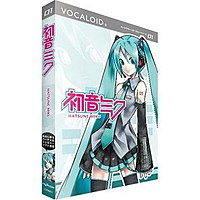
Vocaloid Hatsune Miku
The Internet has dramatically changed subculture scenes worldwide in the last decade. Even in the last five years, after various social networking websites have played an important role in networking people and establishing online communities, subculture fans have shared information and contents they like with others who love the same genre. Some have even created their own pieces such as music, videos, photos, and writings, and posted on their Facebook pages. In Japan, the same things happen, but in a bit different way. People developed online contents collaboratively and share them with other users in a unique way. In the following article, by using the example of Hatsune Miku, I'd like to show how the online collaborative creation process has develop and become a huge phenomena that can no longer be ignored in Japan today.
A digital character called Hatsune Miku has been popular on the Internet in Japan in the last few years. She now became a virtual pop idol in the digital age, especially for the younger generation. For example, the tickets of her two-day concerts held last month were immediately sold out. 10,000 people enjoyed lives at the theater, while more than 120,000 people watched them online. It now becomes more than 123-million-dollor business in Japan. Many kinds of commercial goods such as CDs, figures, and games are sold at the stores and online. For example, SEGA sold more than one million copies of Miku-related games in total so far. At a karaoke shop, more than 1,700 Miku-related songs are distributed and sung by fans. Her songs became so popular that one of her songs was sung in the graduation ceremonies at several junior high and high schools.
Hatsune Miku phenomenon in the U.S.
Click the image to watch Toyota ad
Her name also becomes known outside of Japan. Last year, she had her first ‘virtual’ concert in L.A. with 5,000 audiences (See the live video above). There, she was shown as a projection of 3D animation, as if she were singing on top of the stage. Some big-brand companies also started to use her popularity in the ads. Last year, Toyota featured her in its TV commercial aired in the U.S. She was also featured as a campaign character after Lady Gaga and Justin Bieber in the Google Chrome's global promotion campaign.
Who is Hatsune Miku?
Vocaloid 2 interface shot
Hatsune Miku is the name of an anime-like female character created and released in 2007 by Crypton Future Media, Inc. She is the mascot image of Vocaloid 2, which is singing synthesizer application software developed by Yamaha (Her name in kanji literally means “first sound in the future”). By typing lyrics and melody, a user can synthesize singing so that amateur songwriters can produce their original songs without any ‘real' singers' help for their vocal parts. There are more than 30 types of Vocaloids available now with different characters including male, child, and Korean characters. Miku's voice still sounds a little ‘robotic' for the first-time listener, but the latest model IA in Vocaloid 3 sings songs so perfectly like a ‘real’ singer that the listener doesn't recognize the song being sung by a Vocaloid.
Hatsune Miku as a ‘singer’
Click the image to watch music video
Today many amateur songwriters and musicians use Vocaloid as their ‘singer’ and upload their original songs on YouTube and Nico Nico Douga, which is the most popular video-sharing website in Japan. More than 32,000 Vocaloid-related songs were uploaded on Nico Nico Douga last year. Several songs have become No.1 hits on the charts. For example, the song used in the Google TV commercial called “Tell Your World” by Livetune reached No. 1 on Japan's iTune Store chart. Some professional musicians such as Tetsuya Komuro also started adopting Vocaloid to their music. As a result, many music listeners now choose songs by songwriter's names, not by band's names. In a sense, as Hatsune Miku becomes a ‘common property’ among the listeners, song composition and live performance by a group band are no longer seen as a standard musician style.
Massively collaborative creation
Click the image to watch video
Song writing is, however, just a beginning of the consequent creating process by different kinds of creators. As I examined one of the songs' variation in my previous blog post, a various types of videos related to a song are created collaboratively by many users in different genres (You can see how they are actually interrelated to each other in the video on the right). For example, one user draws illustrations that match to the song, attaches them to it, and uploads the video. The other user sings the song and uploads the video. The other ones create MAD videos based on the lyrics of the song and upload them. Some play the song with musical instruments. Another user choreographs the song, which makes others dance with it and upload their dancing videos. Some create 3D CG video with the Vocaloid character dancing to the song. Another user makes a hit chart of the week including the song. These different kinds of videos are uploaded simultaneously within a few months by many users if the song becomes popular among the them. Several genres such as singing, dancing, and 3D CG are so popular on Nico Nico Douga that hundreds of videos about a popular song are uploaded in each genre. Some of them are watched over a million times. In many cases, the viewers are inspired by other videos and make their own videos. In this way, they form loose creator communities online. On Nico Nico Douga, the reuse of existing videos on the website is welcomed. All users upload their videos in acknowledgment of the videos they used. Last year, the site started its own creator's incentive program so that the video creator can receive a certain amount of money accordingly if the video were viewed a certain times for a certain period. The Google TV commercial (See the video below) describes the collaborative works among different online users very well in 60 seconds without any words.
Copyright issue
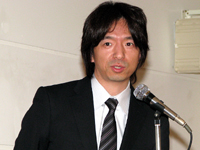
Crypton CEO Hiroyuki Ito
All the creations mentioned above can be done because there is no copyright issue involved. Crypton allows the users to use Miku's voice, name, and image freely as far as it is not commercially used and offensive. In other words, these creations cannot be done with other commercial characters such as Mickey Mouse or Hello Kitty. In this sense, Crypton proposes a new licensing business model. This coexistence between commercial products and fan creations is widely supported by the Internet users in Japan. This is thought partly due to Crypton's CEO Hiroyuki Ito's career background as a programmer and Japan's fan-fiction culture of anime and manga.
Conclusion
Click the image to watch Google ad
“HATSUNE MIKU is not merely music software anymore. It's turned into a source of inspiration to create its derivative works.” --- What Crypton says on its website describes precisely what actually happens on the Internet today in Japan. Miku has emerged as a new type of music creation and consumption in the online-sharing culture. I'd like to see how this ‘digital diva’ will change the music scene also in the world.
The following article was written as an assignment for the Cyberspace and Society class.
While a controversy over the Stop Online Piracy Act is going on and the copyright laws are defined and more controlled not by the government but by private companies in the U.S.(Mazzone), a similar thing also happens in Japan. In the negotiation of the Trans-Pacific Partnership (TPP) between ten countries, the U.S. Government tries to strongly push its copyright policy on the other countries based on its national interests. Japanese Government recently announced to join the TPP although there is strong opposition by the public for a fear that domestic industries such as medical services and agriculture would be wiped out by foreign companies and investors. Coincidentally, the copies of U.S. TPP proposal were leaked to media (Chirgwin). Here is a part of the intellectual property chapter of the list:
Copyright
Copyright damages shall consider the suggested retail price or other legitimate measure of value submitted by the right holder.
(art. 4.5) The term of protection of a work (including a photographic work), performance, or phonogram is to be calculated:
on the basis of the life of a natural person, the term shall not be less than the life of the author and 70 years after the author’s death;
on a basis other than the life of a natural person, the term shall be: (i) not less than 95 years from the end of the calendar year of the first authorized publication of the work, performance, or phonogram, or (ii) failing such authorized publication within 25 years from the creation of the work, performance, or phonogram, not less than 120 years from the end of the calendar year of the creation of the work, performance, or phonogram.
Would eliminate any possibility of parallel trade in copyrighted books, journals, sheet music, sound recordings,
computer programs, and audio and visual works (i.e., categories of products in which the value of the copyrighted
material represents substantially all of the value of the product) (art. 4.2, and footnote 11)
Each Party shall establish or maintain a system that provides for pre-established damages, which shall be available upon the election of the right holder
Requires criminal enforcement for technological measures beyond WIPO Internet Treaties, even when there is not copyright infringement (art. 5.9)
Impose a legal regime of ISP liability beyond the DMCA standards (art. 16.3)
Requires legal incentives for service providers to cooperate with copyright owners in deterring the unauthorized storage and transmission of copyrighted materials; (art. 16.3.b.vi.A)
Requires identifying internet users for any ISP, going beyond U.S. case law (art. 16.3.b.xi)
Includes the text of the controversial US/KOREA side letter on shutting down web sites
There are several points that may cause critical damages to Japanese sub-culture. One of which is the provision of protection of a work (article 4.5). Under the copyright law of Japan, the length of protection was recently changed from 50 to 70 years (after the first release of the product) under the pressure of other foreign countries. The U.S. now tries to widen the period for a maximum of 120 years (this U.S. provision is called Mikey Mouse Protection Act in the U.S.). If this new law were enforced in Japan, all the copyright-free contents on the Internet might vanish. The other point which seems to include a potential threat to Japanese sub-culture is the rising cost of compensation. Under the first clause of the list, it says, "Copyright damages shall consider ... other legitimate measure of value submitted by the right holder," which means that copyright owners can file a lawsuit demanding however much money they want from the person who violates the law.
The agreements above are to make a copyright law uniform across all the signatory countries, but so far it's only beneficial for the U.S. In 2010, the U.S. earned $134 billion in international sales and exports that were related to the intellectual property (AAP), whereas Japan ended up with a deficit of $6.4 billion. These agreements include stricter protections than the WTO's Agreement on Trade-Related Aspects of Intellectual Property Rights (Pharma Japan).
The TPP's potential impact on Japanese sub-culture seems so huge that some anime and manga artists started to raise their voices. A comic writer Ken Akamatsu claimed that "the culture developed through parody and dojinshi works would be harmed" and " as a result, the power of the entire manga industry would also diminish" (Kiko). (Dojinshi is a coterie magazine or fan-zine based on the characters of anime and manga. Many comic writers and anime creators are involved in this in Japan.) A media artist Kazuhiko Hachiya said that "the resulting changes in the Copyright Law of Japan would affect cosplay"(Yaraon!) (Cosplayis to dress up as one's favorite character in anime or manga.) As I pointed out in my previous blog post, Japanese love fan fiction very much and the derivative works often develop into a sub-genre of modern Japanese sub-culture. For example, most of the videos uploaded on Nico Nico Douga are fan creation. Recent emerging sub-culture such as Vocaloid and Touhou Project could not have established as a sub-category on the website if the fan creation would have been banned.
To examine more in detail, there are two main differences between the present copyright law of Japan and that of the U.S. One of them is that under the current law in Japan, the police cannot act against copyright infringement unless the copyright holders file a formal complaint, whereas such complaint is not required at all for prosecution in the U.S. If the present U.S. law were applied to Japan, the police would have the discretion on what to prosecute (Yaraon!). (As a result, some manga and anime for adults would be probably targeted first). The other different point is that unlike the U.S., there is no "fair use" provision in Japan's copyright law (There are a limitation and exception to the exclusive right which is similar to the U.S.'s fair use provision, but the idea is completely different). This "fair use" provision may help fan creation in Japan from being punished, but this is the one that the U.S. Government would never export to other countries since the provision would conflict with the national interests of the U.S.
Copyright has been argued more often than ever before as digital copies become more available among people in this Internet era. It may be the time for us to think about copyright again. In an article, a sci-tech writer David Bradley introduces the fact that classical composers such as Vivaldi and Beethoven composed much more music pieces than the contemporary composers in the 20th century do and says, "... copyright laws, while protecting vested interests, have simply stifled creativity" (Bradley). To begin with, we Japanese at least have to decide what position Japan should stand on with regard to TPP negotiations regarding intellectual property.
The following article was written as an assignment for the Introduction to Media Theory class.
I had a chance to research on the pop-culture contents on the social media and present it in a group in another class recently. Since I could not fully express my idea there, I'd like to expand it and present it here.
[Introduction]
Compared to YouTube users, Japan's Nico Nico Douga users are more likely to be involved in social media activities without revealing themselves, which leads them to generate unique and interesting pieces of work of their own by focusing more on imaginary characters or characterizing themselves. Here I'd like to illustrate it by examining how the users play with a song and create their own videos.
[Example videos on YouTube]
[Example 1] Symphony Orchestra 2011
The website above asked the viewers to join a temporary orchestra by posting videos on YouTube. The contest had clear procedure and rules for the participants to follow on their website. After the members were selected, they converged in Sydney for a week-long festival of musical collaboration and participation (101 members from 33 countries got together).
[Example 3] We Are The World (Ukulele style - 33 ukulele players from all over the world)
[Features and tendencies of the participants in the YouTube videos]
As you know, many people sing a song and perform music, and upload the videos to YouTube everyday. So many people have posted their own "We are the world" videos since YouTube started. What I'd like to focus on here is the way they play with the original song or music online. In both examples, all the performers show their faces in the videos and their names are listed on the description pages. As for the quality of the performances, most of them are quite good (that's why they are chosen by the editor of the videos). Although each singer/performer has his or her own style and characteristic, the whole performances are quite close to the original song. The videos are edited quite simple and clear. More highly-skilled and professional-like users tend to participate (especially in the case of Symphony Orchestra). This is probably because there were clear rules and instruction addressed and it had fewer barriers (such as a language barrier) so that a wide variety of people could participate in the event from all over the world. As the whole population of YouTube users in the world is so huge, the quality of the top-level works tends to be very high (They are often performed by professionals).
[About Nico Nico Douga]
On the contrary, Nico Nico Douga is not open to all the Internet users like YouTube. One has to become the member of the website to watch the videos. It targets only for Japanese and those who understand Japanese (There are Nico Nico Douga websites also in English, French, German, and Chinese, but they are totally different). As a result, not so many people can enjoy it compared to YouTube. The whole population and the numbers of uploaded videos are very different between them. However, in Japan, Nico Nico Douga has gained a large membership. It now has more than 25,500,000 members (As of July 2011). It is very popular especially with the young generation. About two third of the members are in their teens and twenties. More than two out of three people in their twenties have a Nico Nico Douga account in Japan.
[Vocaloid songs and the variation of Happy Synthesizer videos]
There are many amateur composers uploading their original songs to Nico Nico Douga in Japan. Many of them use a singing synthesizer application software called Vocaloid so that they can put the synthesized voice on the vocal part without asking some one to sing the song. It is estimated that more than 20,000 Vocaloid songs are uploaded so far. Among them, a song called “Happy Synthesizer” was originally posted on the website last year on November 22 by an amateur composer then named easypop (His real name is unknown. He now becomes professional and released his first CD a few months ago).
[Example 4] Happy Synthesizer (uploaded on YouTube)
The song became very popular (more than 1,300,000 times viewed so far on Nico Nico Douga and about 1,200,000 times on YouTube) and many users started to consume or play with the song in their own ways by uploading their own videos related to the song. Here is the chronological order of how they have enjoyed and reproduced it.
1. The composer posted the original song on November 22, 2010.
2. Many users started to post their own videos singing the song. (1,500 videos were posted so far.)
3. Its English version was also made and sung by the users.
4. Some users performed the song with different kinds of instruments such as piano or guitar.
5. Several dance remixes were made.
6. A dancer choreographed the song on December 3, which is two weeks after the original song was posted.
7. Many users started to dance on the choreography and post the videos. (More than 1,800 videos were posted so far.)
8. Some user groups had off-line meetings all over Japan, danced together and posted the videos.
9. Several users traced the dance and made 3D CG videos using a free 3D modeling software called MikuMikuDance (MMD) at the end of March next year.
10. Many MMD users started to create their own CG videos with their favorite characters. (About 300 videos were posted so far)
Here is a variety of the videos posted based on the original song. (I edited them into one video so that you can visually see and understand how the original song has been consumed and developed by many users.)
[Example 5] Variation of Happy Synthesizer Videos
[Features and tendencies of the participants on Nico Nico Douga]
These variety of videos based on the original song have been generated by many users within almost four months (and they are still making new ones everyday). The users created their videos in these ways partly because there are such categories set on the website, which encourages them to create in these ways. Since not so many users are expected to participate in the activity in each category, the quality of the works on average is not so good as that on YouTube. Most of the singers and dancers do not seem to have any vocal or dance trainings. They are far from professionals, but they posted their videos because they love the song. One of the most explicit features of the users is that most of them do not reveal their faces or real names in the videos or on the description pages on the website. They usually use their user names with no real face photo. Not only the music composers and 3D CG creators do not reveal themselves, but also the singers and music performers do not do that either (which is totally opposite to those in the YouTube videos). Even more than half of the dancers wear masks while they are dancing in order not to be identified themselves. As often said, it may come out from the Japanese sense of "Shame” or “Haji” in Japanese, but it may have an effect on the users' creativity in somehow.
[Comparison and conclusion]
Japanese tendency not to reveal oneself online is often pointed out for the reason why facebook is not so much popular in Japan. It can be also said to the tendency of Japanese twitter users that many of them do not put their real names or face photos on their profiles. Here I'd like to put focus on how this tendency effects on the creativity of modern Japanese sub culture. It is difficult to draw any patterns or principles just from these few examples from YouTube and Nico Nico Douga, but I'd like to draw a hypothesis on this phenomenon anyway. For the performers in the YouTube videos, the original song or music they sang or performed is just a medium or tool to prove their performing techniques, and the viewers appreciate the performances and evaluate the performers or performers' skills rather than the work pieces themselves. In other words, for them the video is just a result or proof of their performances and the applause is given more to the participants themselves rather than their works. On the other hand, Nico Nico Douga users seem to be more interested in the videos as a work piece or the ways the song is expressed. The viewers do not seem to care much about who the creators of the videos are. More specifically, they are more interested in playing with the song or the fictional characters involved in the song (In this case, they are the vocaloid characters such as Hatsune Miku). The dancers in the videos seem to show and characterize themselves as cute and lovely as possible with their fictional user names (Some of them actually did cosplay and became one of the vocaloid characters). The viewers are more likely to appreciate the dancers’ characters (which is called “kyara” in Japanese) and enjoy them without any questions who the dancers really are. Same thing can also be said to the creation of the 3D CG videos. When the variation of the video expanded to the 3D CG phase, more high-quality videos were made intensively. It seems that all the performers, creators, and viewers tend to focus more on the characterized figures in the videos rather than on the creators. In a sense, they express themselves through their favorite characters or characterized self-images. They tend to erase their bodily images as the subject of the action and leave only the deed (in this case a piece of work) in order to enjoy or consume the topic with the following members in the same but small interest group who have the same taste. It is hard to prove this, but I think this Japanese tendency not to reveal oneself online seem to have a close link to the reason why Japanese people love so-called “characters” so much.